Showing posts with label geography. Show all posts

Monday, March 9, 2015

Homeschooling Multiple Ages - Teaching and Reteaching Subjects


When teaching multiple ages at home, especially if you do a lot of group lessons and activities, it can be easy to fall into the trap of teaching a subject once, and thinking you "have it covered".  Of course, what you've really done is "teach" to your older students, and allowed the younger students to tag along.  They will most likely not remember the entire lesson, and will need to have it retaught as they get older.

That is how, even though we've had a few fairly thorough lessons on countries and continents through the years, that I could find myself in a conversation about the continents this week, and discover a large hole in the learning of my youngest.

"What continent do we live on?" I asked, for some reason that escapes me now, but went with our conversation then.

I received blank stares as an answer from my youngest two.

"Okay what country do we live in?

That one they knew.  "The United States of America."

"Good, and what continent is the United States a part of?"

Blank stares again.

"Can you name any of the continents."

"Canada?"

At that point one of the teens yelled, "Oh come on!" from the the living room, and I realized it was time for another lesson on the continents.  Looking back, I realized the last time we'd really covered the continents in earnest was the better part of four years ago, when E was 6 and C was 4.  A review was in order.

I dug our Ravensburger Discover and Learn Continents Puzzle (non-affiliate link) out from the back of the game cupboard...


...and had the girls put it together, and trace the map included with the puzzle...


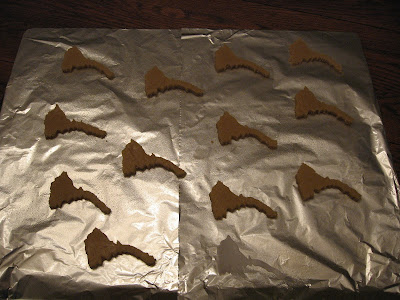
...to make wax paper templates for cutting sugar cookie continents - again.  In fact the two pictures above, and the one below were from our 2011 cookies, but the process was just the same this time, so I didn't bother with photos.


This time around, the younger girls did all of the tracing cutting, frosting...


...and arranging.  And, just to shake things up a little, I had the them watch a BrainPop clip on the continents, and found a terrific (and free) online mapping game for them to play as well.


T (age 17) wandered through the kitchen about the time the girls were arranging the cookies on the table, and asked why we were making "those" again.  I assured him it was them and not we who were making the cookies.

He thought that was fair, even if his little sisters did demand that he "name the continents" before they let him eat one.

At any rate, the moral of the story is when teaching multiple age groups at the same time, don't forget to cycle back through the lessons as younger children grow up.

Tuesday, October 7, 2014

Phineas and Ferb Geography - Finding Danville.


Inspired by the great independent work projects going on over at angelicscalliwags, and a Google search item I happened to see on one of the children's internet histories - we came up with an independent work project of our own.

I asked each of the teens to research, and decide for themselves whether the town of Danville, in which Phineas and Ferb (from the Disney show by that name) live, could be based on an actual city in the United States.  According to a purported email from the creators of the show, to the administrator of the Phineas and Ferb Wiki-site, the city of Danville, named for Dan Povenmire, in Jefferson county, named for co-creator Jeff Marsh, is a fictional city, that can be located anywhere in the country, depending on what works for a given episode.

Even so, I challenged the children to decide for themselves.  Could Danville be based on a real town, named Danville, or not.  I gave them a week to research cities looking at population, geographical location, amenities, topography, and so on.  Their assignment was to be ready at the end of the week to present, and defend their findings in an oral report, preferably with visual aids. 

A (age 13) went old school, and used the overhead projector we bought last summer at a country school close-out sale, to display a map of all of the Danvilles in the United States...


...eliminating them all, and then settling instead on Fontana, CA, because of it's population...


...amenities, and proximity to the ocean.


G (age 15) chose to prove that Danville could not possibly exist as a real city.  She cited nearby places of interest mentioned in various episodes - the mountains, the beach, Mt. Rushmore, Washington state, and the Eastern seaboard.  The fact that it is a city with palm trees, and snow in the winter. And, the centerpiece of her presentation...


...was a song from season 4, that does seem to shed some doubt on the existence of the entire tri-state area.


T, was unshaken though, and forged ahead with his presentation...


...complete with computerized slideshow of pictures gathered from all over the internet, then modified for the purpose.  His presentation followed along the lines of...

  1. The city of Danville could be be based off of an actual city.
  2. This could probably be proved definitively, if it were not for the cycle of procrastination.
  3. There are a number of cities in the US named Danville.
  4. A few are within a one day drive of Mt. Rushmore, but...
  5. ...they are all very small towns - unlike the city of Danville in Phineas and Ferb.
  6. However looking within a 10 hour drive of Mt. Rushmore...
  7. ...for a city with at least some of the amenities of Danville - namely a racetrack, museum, and skyscrapers...
  8. ...is Denver, CO...
  9. ...which does have a racetrack, museum, and skyscraper...
  10. ...though not the unusually shaped purple skyscraper seen in the cartoon.
  11. Still, a compelling case could be made for Denver as the inspiration, if not location, of Danville.
Finally, I pulled out the map (pictured of the top of this post) from a season 1 episode, with a United States map pushed and pulled into place over it in Paint.   Allowing for Dr. Doofenshmritz' poor map drawing skills, he could be magnifying California, Colorado or Salt Lake City, Utah (my choice, if anyone had thought to ask me) as the location for the tri-state area, and Danville.


But then, the purpose of the project wasn't really to find Danville at all, but rather to provide an excuse to put together presentations, work independently, make speeches, deal with a deadline, sharpen our critical thinking skills, and have a good time together watching as many episodes of Phineas and Ferb as we could fit into one long marathon session.

It's great to be a homeschooler.

Tuesday, September 16, 2014

Playdough Mat Maps and Furry Distractions

Getting ready to head into two different novels set in Canadian provinces, Farley Mowat's Owls in the Family, in Saskatchewan...


...and Margaret Craven's I Heard the Owl Call My Name, which takes place in British Columbia...


...it seemed like a good time to throw in a quick country study.  We normally begin our country studies with a sugar cookie map project.  This morning though, noting from a number of posts in my blog reader, that it was play dough appreciation day, and seeing at the same time a couple of interesting mapping ideas from Die fantastischen 5, and angelicscalliwags  I decided to take an easier route, and follow the crowd.


Before the children got up this morning, I printed out a couple of maps of North America, one with the provinces, and states colored and labeled, and another that was just a blank outline.  I slipped the maps into plastic page protectors, and placed them on the breakfast table with a couple of cans of Play-Doh.

C (age 8) took right off covering the provinces, and a few states that matter to her, with Play-Doh...


...while E (age 9) began covering all of Canada with a single color of dough.


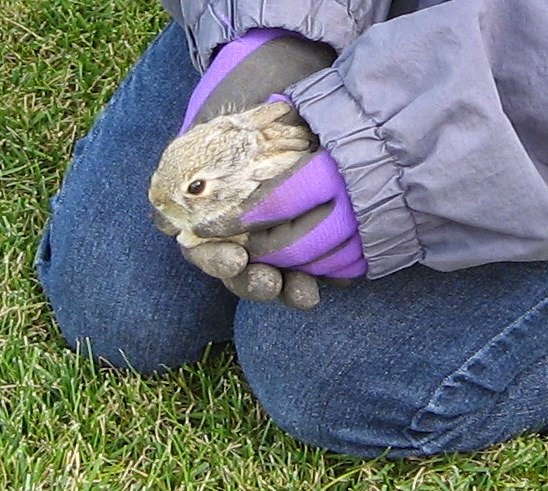
I had great plans for having them mark capital cities, and add major rivers, and such, until I spotted the baby bunny trapped in one of our basement egress window wells, and all thoughts of Canada were forgotten, in favor of a full scale rescue mission.


Which is not in anyway to say Canada is boring, or even the least bit uninteresting.  But, really how could any country compete with so much cuteness?


I had my hands full convincing the children, that unlike Farley Mowat's heroes, they could not keep their rescued "pet", and that wild animals, no matter how soft and cuddly, belong in the wild.  Thankfully for my cause, the only owls we've seen since moving into the neighborhood have been either on the pages of our books, or the walls of our dining room, or I'm quite certain we'd have a stowaway rabbit being "kept safe" in somebody's closet tonight.

Monday, March 3, 2014

Snow Day Unschool-Style


Freezing rain on top of snow canceled schools in our area today.

Map from Wikipedia

It's great to be a homeschooler.

Tuesday, July 3, 2012

Stars and States Snacktivity


We've been working through the symbolism on the American flag this week, so when A (age 11) ask if she could invite a couple of girlfriends over for the afternoon, I said, "Sure, you guys (translate that to y'all if you live in the South) can help me decorate some cookies."


I didn't tell her that there'd be a civics lesson thrown in, as well.  The girls didn't seem to mind, though.


I set them up with 50 star cookies, made from a single batch of plain sugar cookie dough (click here, for the recipe) laid out in 11 rows flag-style, a map of the United States, and three bags of frosting - red, white, and blue, with a tiny corner snipped from each one, so the girls could use them to pipe a state abbreviation onto each of the cookies.

The girls worked feverishly, with a little bit of chaos as they realized two states had been duplicated, raising the total number of stars to 52, and my left-hander had some issues with the piping bag, but all in all they did a fantastic job, and I think they might have even learned an abbreviation or two they didn't already know.


As a reward,  I pulled out an extra cookie for each girl, and the rest of my own children, to decorate as they pleased.  Not that we needed more cookies, mind you, but it really did bring out the creativity, zaniness, and individuality of each child.


Of course, now no one get to eat any of the state stars unless they can identify the abbreviation on the cookie.


It's great to be a homeschooler.

Friday, March 16, 2012

Can Butter Conduct Electricity? And Other Questions For Children From Burkina Faso

Turning back to our study of Africa, the children and I, joined by the Man of the House at lunchtime and in the evening, spent most or our day yesterday, lost in the cities and deserts of Burkina Faso, with Stephen Davies' teen thriller Outlaw.

In fact, we found the fast paced, action adventure trek through the political underbelly of the small west African nation is so riveting, I think we might actually have finished the entire two hundred and eighty some pages in a marathon family read-aloud session, if we hadn't gotten distracted midway through by a science experiment, we just had to try.


Jake, the 15 year old protagonist of the story, finds himself kidnapped, along with his 13 year old sister Kas, and hauled out to a remote location in the desert. Along the way, he manages to make a few frantic calls to his father, the British ambassador, before his cell battery goes dead. Out of cell range, but hoping for a rescue, the teen charges his phone using a couple of batteries from a flashlight, and some goat's milk butter.

In a "what is fact and what is fiction" section at the back of the book, that made my homeschool heart happy, the author sights a YouTube video on "How to Charge an Ipod with Batteries and Whipped Cream", as inspiration for the stunt.

We looked up the video, and then decided to do a little experimenting ourselves. In the book, Jake simply lays the batteries together on a metal plate (he'd been given to eat on)...


...shakes his goat milk in a handy gourd, until it turns into butter, slathers the butter over the batteries, and sticks his charger cord, connected to the his phone, right into the butter.


The YouTube video works pretty well the same way, except using whipped cream instead of butter, and a ceramic plate. I didn't want to risk a perfectly good charger cord with destruction by butter, so instead pulled out the odd bits and bobs we have left from old science kits, and chose a little motor, inserting the terminals right into the butter.

Nothing happened, even when we tried upping the juice with four AAs in our Leapster's battery pack.


We remembered we've had luck in the past, running electrical current through a bit of playdough, so we set up a control experiment, using playdough to complete a circuit between our battery pack and a small, but loud, buzzer. The playdough worked perfectly.


The butter however did not. We tried it with salted, unsalted, melted, and hard butter, and on a nonconducting plate...


...verses a conducting spoon. And while the spoon alone could be used to complete our circuit, we just couldn't get the butter (or whipped cream, which we also tried) to conduct a current.


The closest we came to the feat of the book, was using buttermilk (left over from our Irish soda bread), with about tablespoon of salt added in.


Jake's goat butter might have been more buttermilk than butter, but there's no mention of him adding any salt, so we're filing that page of the book under pure, but really fun, fiction, and moving on. The rest of the story is filled with enough techno babble, teen terminology and African geo-politics to keep us happily busy, at least until we can get to the library for the next Stephen Davies teen novel - which I believe is set in Mali.


It's great to be a homeschooler.

Linked with:


and

Science Sunday

Saturday, March 3, 2012

Cookie Map Correction - Eritrea


I was informed in the comments under our cookie map of Africa, that I had missed making a cookie for Eritrea.


Actually, I'm sure I missed more than one country, the country borders in Africa seem to move and reshape every time I glance away, but I had some left over dough, so I figured we could at least rectify the lack of Eritrea on our map...


...with the help of a photo editor, anyway.


In reality, we enjoyed our plate of Eritrean shaped cookies later in the week, separately from the rest of Africa, along with a couple of very good picture books, set in that country.

The Mangrove Tree, Planting Trees to Feed Families, tells the true story of Dr. Gordon Sato's "Manzanar Mangrove Initiative", planting mangrove forests in dry, desolate areas of the world, like Eritrea, to alleviate poverty, and reduce global warming. The story is told in short verses above mixed media illustrations, with longer text boxes to the side. You can read more about the project detailed in the book, here.


Trouble by Jane Kurtz, who grew up in Ethiopia while Eritreans were fighting for independence, tells a fictional story of a young boy, and the gebeta board his father gives him to keep him out of trouble. The game (one of the many forms of the game also known as mancala) doesn't exactly do its job, but it does lead the boy on an interesting, and eventful journey around the countryside, and safely home again.


Mancala is one of the oldest board games in the world. What it's called, and how it's played varies from country to country across Africa and the Middle East.

Depending on the rules of play, some of which you can view here, it can be a simple count and capture game for children, or a challenging strategy game, akin to chess, for adults. Like many folk games, the board is simple, and can be reproduced at home, with holes dug in the dirt, carved into wood, or even made out of recycled egg cartons. However, we purchased ours, for less than six dollars, after friends introduced us to game, last summer. Naturally, we've been playing it with renewed interest, and hopefully keeping out of trouble too, this week.


It's great to be a homeschooler.