Looking for things to do, with your children, this spring? I just found a excellent list of "101 Things to Do This Spring" over at BackyardNature.net.
Not only is it a great list of things to do outdoors, but it contains tons of terrific links, and book recommendations. Be sure to check it out! I know we will be, just as soon as I finish Googling a few answers to early spring questions like:
"Mom, are worms not insects?" (They're not, by the way. They are annelids.)
It's great to be a homeschooler.
Saturday, March 26, 2011

Friday, March 25, 2011
Pom-pom Birds

The salt dough nests were finally dry enough to paint, this afternoon.

And, since not everyone had made a nest, I tossed out some large pom-poms, craft feathers, google eyes, craft foam, and glue, in case any of the rest were feeling crafty.

There were a few takers. Really, who can resist a large pom-pom with googly eyes?

I had to help C (age 4) with the pipe cleaner feet...

...but other than that, they were able to put them together on their own, which is always fun. They won't be "to play with" toys, as we only used school glue, but I think they'll look very cute, on the children's shelves, or window sills.

It's great to be a homeschooler.
Cookie Bird's Nest Snacktivity for Children
After driving all over town, the day before, to spot our first robin of the season, we spotted one right from our own kitchen table, yesterday (and yes, our neighbor's house is really that close, but he's a very nice older gentleman, so it's okay).


 If we're understanding Stan Tekiela's photos and descriptions from his Birds of Montana Field Guide, then both birds we saw, with their bright breasts, and black heads, are males. Mr. Tekiela has state specific bird guides for most, if not all, of the other states, as well, and I highly recommend them for beginning birders.
We thought our robin looked as though he was scouting for a good nesting sight. This would make sense, since according to Robins by Sharon Sharth, our story time read last night (a good non-fiction look at robins, for younger children), the males show up slightly before their mates, to do just that. They are also very territorial, and often return to the same area year after year. So, we might have seen this guy last year, too.

Our salt dough nests weren't quite dry enough to paint, so we had a build-your-own nest snacktivity to go along with our story, instead.

I made up a batch of chocolate sugar cookie dough (just regular sugar cookie dough, with 1/4 cup of baker's cocoa added in), and rolled it out as thin as I could, on wax paper.

Then, I transferred the entire, rolled out batch, to a greased cookie sheet...

...used a pizza cutter to cut it into sticks...

...which I baked at 350 degrees Fahrenheit for 12 minutes, and then cut apart again, while they were still warm.

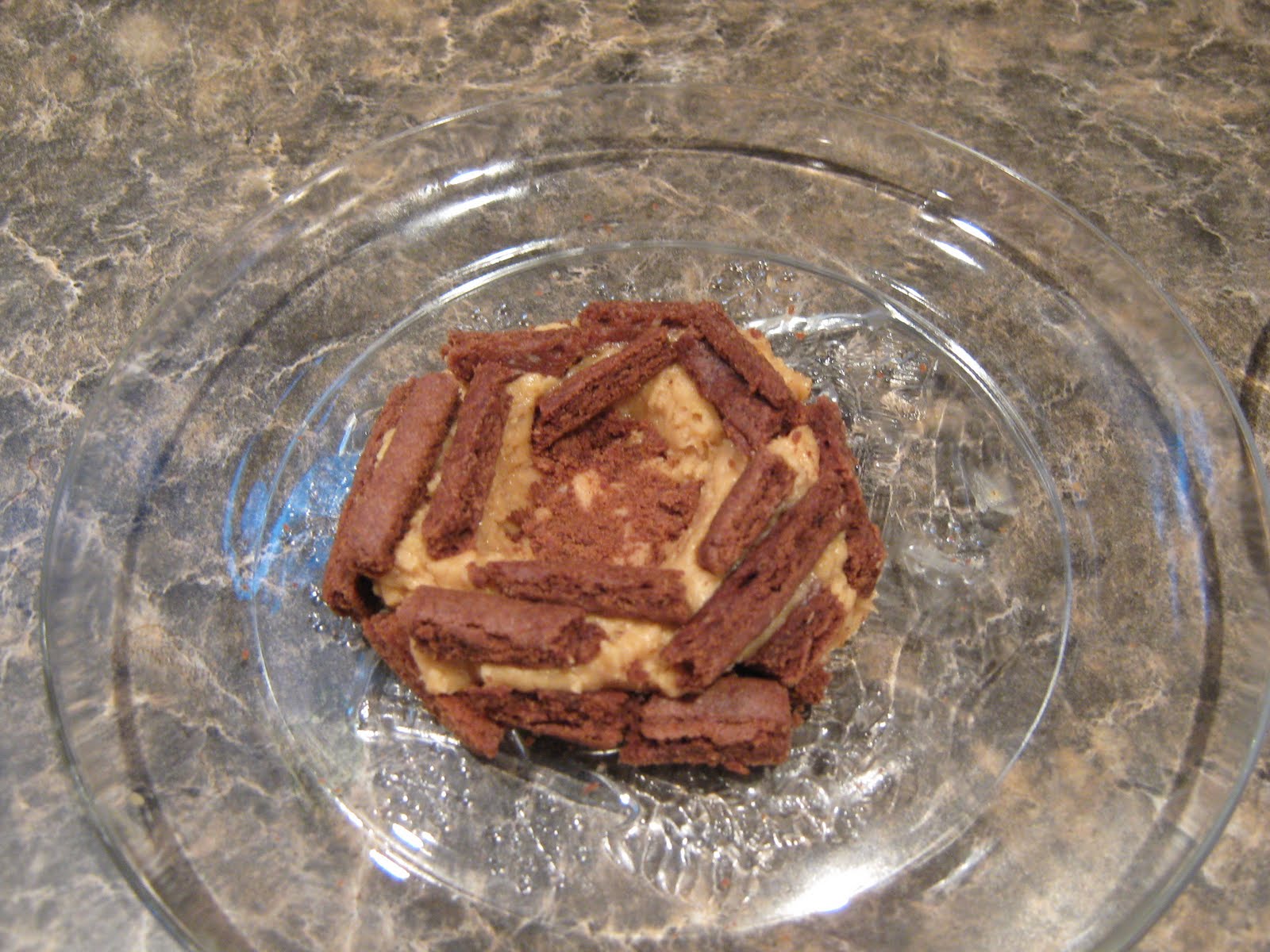
Once, they had cooled, I gave a few to each child, with some peanut butter frosting (2 cups powdered sugar, 1 cup creamy peanut butter, and about 4 tablespoons of milk), to make nests with.

My original thinking was for them to stack the cookie sticks, dabbing frosting "mud" between them, to hold them together. But, that proved difficult...

...so instead, I placed a little "bowl" of frosting on each of their plates, for them to stick the cookies onto, pretty much like we had made the salt dough nests.

It was a little more frosting than I knew they'd eat, they just pulled the cookies back out, and scraped the extra frosting to the side. But, the nests were a lot of fun to make, and gave us a fresh appreciation for the amazing work birds do building real nests - without hands, even.

It's great to be a homeschooler.
Thursday, March 24, 2011
Salt Clay Bird's Nest Craft
We had two stories to go along with our stART (story + ART) project, this week. The first was Constantine Georgiou's The Nest...

...a simple, old fashion sort of picture book, about a robin building her nest, strong and secure, and filling it with soft bits of fluff, to make it a warm, and safe place for her eggs. And...

Our Nest by Reeve Lindbergh, that expands out from a child in bed, to a bird in its nest in the tree, to the deer sleeping in a grassy nest in the field, clear to the fish cradled by the earth in the watery nest of the ocean, and ultimately into space to see the earth in the nest of the universe, and then zooming back in to the child in bed, and the safety of his mother's arms.
"We're here in the nest of creation
With the earth and the stars above.
And you're here, safe and warm, in the nest of my arms,
When I wrap them around you with love."
It's a very cozy, bedtime story for little ones.
I was going to just have the younger children work at making play dough nests, while I read to them. But, I decided to mix up a quick batch of salt dough (1 cup salt, 2 cups flour, 1 cup water), which is not as much fun to work with, but will dry nicely, giving us a project to paint, later today.
But first, for the nests:
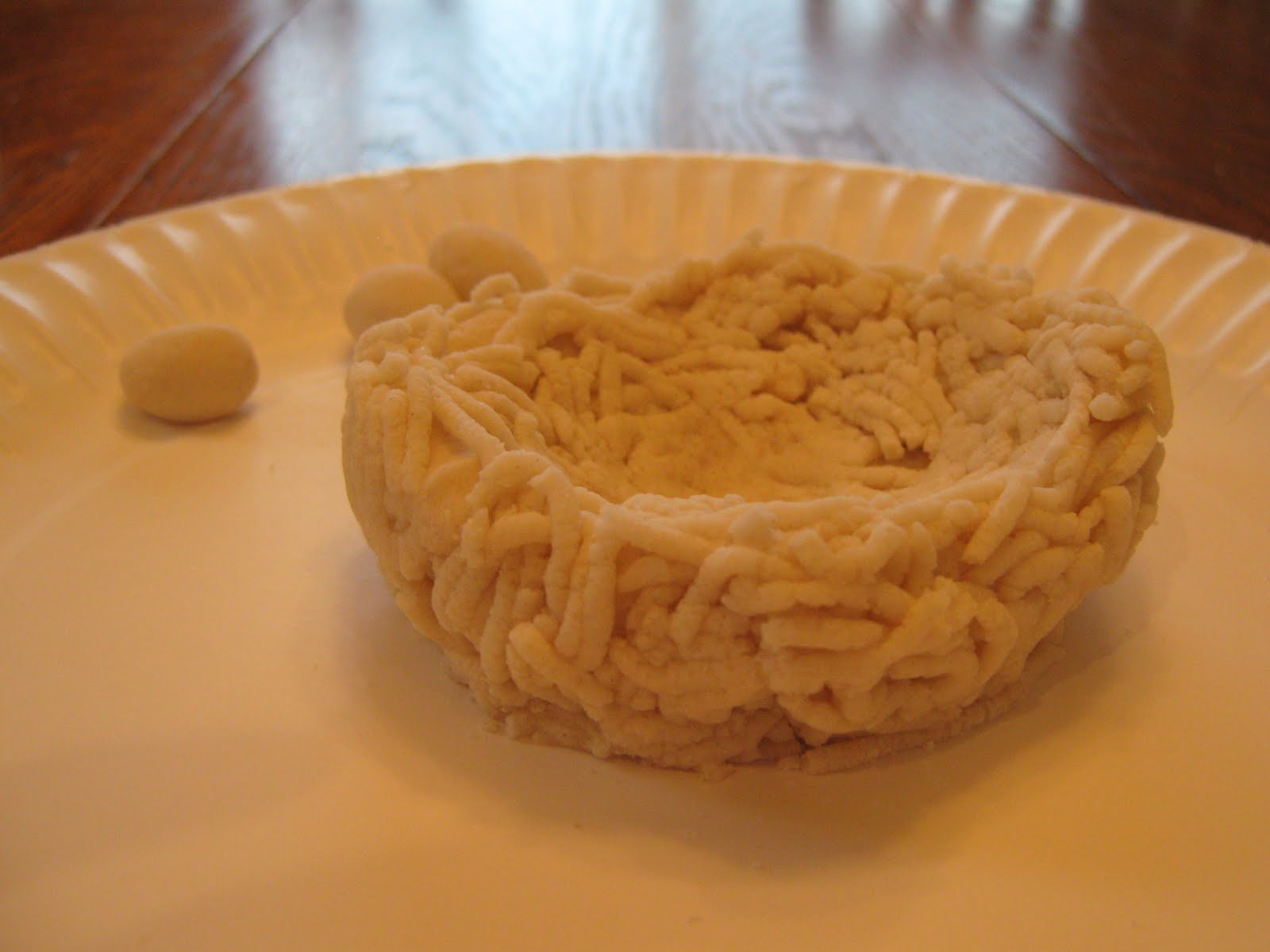
The girls started by pressing small globs of dough, down into bowl shapes.

They used a garlic press to create long strands of noodle-like dough...

...which they broke apart, and pressed onto the bowl, all the way around, and inside (an idea from create-kids-crafts.com)...
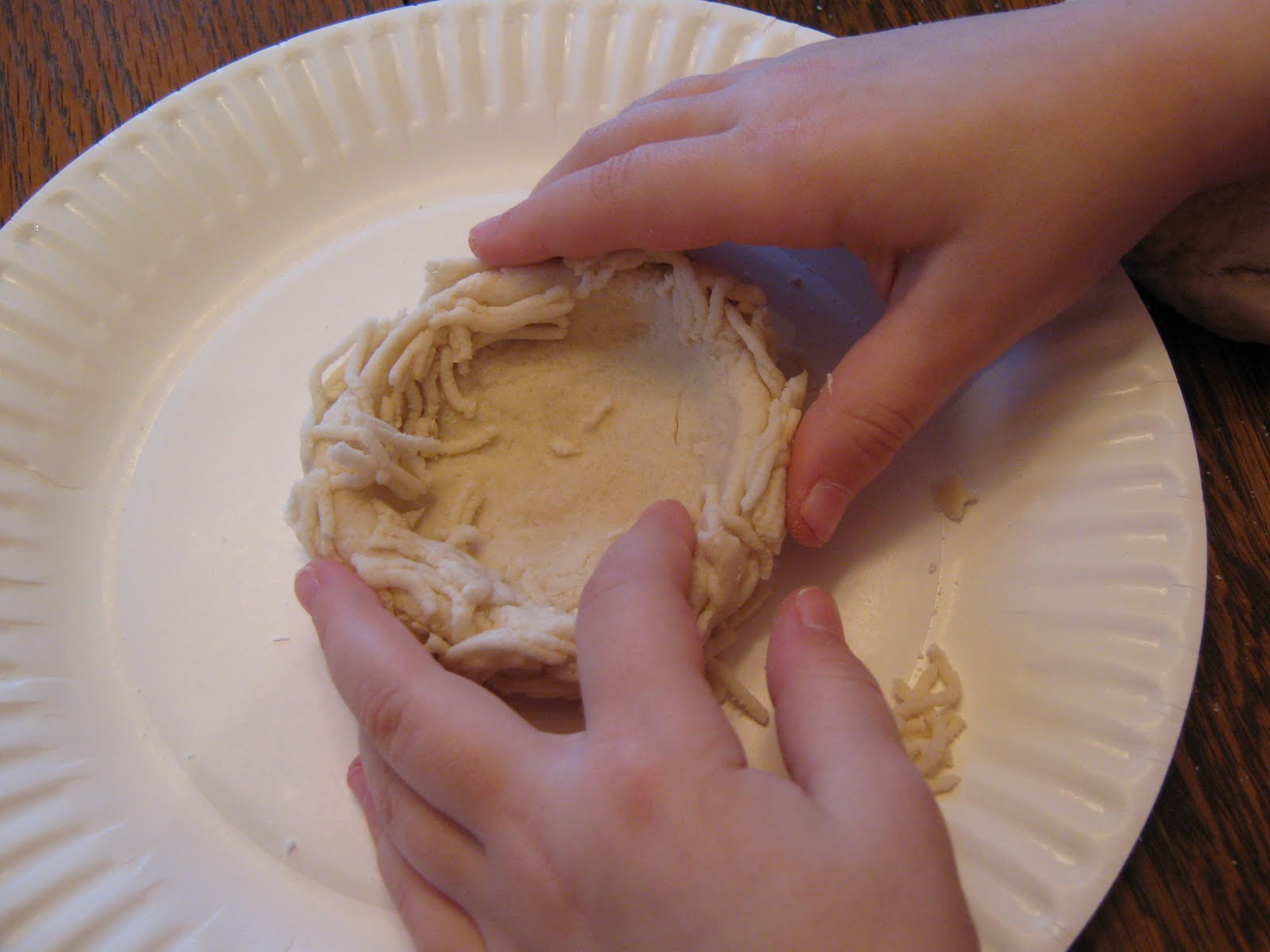
...to give the impression of twigs, and bits of straw.

Making the noodles with the garlic press was fun, and so they ended up with more than they needed for their nests, so they rolled the left over bits into small egg shapes, to dry with their nests. We left them on the counter to air dry over night, and hopefully they'll be dry enough to paint by this afternoon.

Click the link below, for more story themed arts, and crafts projects for children.

It's great to be a homeschooler.
Wednesday, March 23, 2011
Robin Counters
Remember the wood bead, penguin counters we made to practice counting by 10s, in January?

Well, they got a make over...

...in honor of our spotting our first robin of the season, in a vacant lot across town, today.


This time we're counting by twos.

Despite the threat of snow, still in the air, I think it's safe to say, that spring is here. Yippee!!!
Well, they got a make over...
...in honor of our spotting our first robin of the season, in a vacant lot across town, today.

This time we're counting by twos.
Despite the threat of snow, still in the air, I think it's safe to say, that spring is here. Yippee!!!
It's great to be a homeschooler.
Children's Books About Japan - Library Therapy for Children
The School Library Journal recently reprinted World Vision's "Eight Tips for Talking to Kids About the Tragedy In Japan", adding to it a list of book recommendations to help with discussion, children's curiosity about Japan, or for dealing with fear about earthquakes and tsunamis. I highly recommend reading World Vision's tips, especially if you have younger children, who might have overheard some of the news, lately.
And, I found a few of the suggested books at our library. Caught off guard by the scope of devastation coming across the Internet from Japan, I didn't pay close enough attention to who was in the room, as the news stories played, and the children, even my youngest, heard and saw more than they could process alone. These books, as well as some of the tips above, have been very helpful in answering questions, and restoring their sense of calm.
 We read Tsunami! by Kimiko Kajikawa, to go along with E's robin collage, because Ed Young uses paper, and cardboard collages to illustrate perfectly, the devastating power of a tsunami, as it destroys a coastal village. But, in this story, the quick thinking, and sacrificial act of one man, saves the lives, if not the homes, of the villagers.
It's a good story, because it focuses on people helping each other, and offers a hope for the future - that bad times, and good times wash in, and out like the tide.
We also read CHIBI: A True Story from Japan, about a Tokyo community's concern for the welfare of a small duck, and its family. This story deals with a flood, instead of a tsunami, but the central theme of community joining together to help, even the least of its members, is similar to what we are seeing out of Japan, today.

The children enjoyed the peek at life in modern Tokyo, and the inclusion of a number of Japanese words, with a small English/Japanese dictionary, and pronunciation guide, at the back.
And finally, I also checked out Jim Haskin's Count Your Way through Japan, which is not on the School Library Journal's list, but came up in our library listing of children's books on Japan.

It turns out to be a very good anthropology/geography picture book, counting its way (in Japanese) through the Japanese culture, and map. Eight, for instance, is for the eight major geographical regions of the country, something of interest the children had picked up from the news (and from a previous a interest in Pokemon), and something they were happy to learn more about.
Three is for the three things the Japanese people learn early in life to fear in nature - "earthquakes, fire, and typhoons", with a few paragraphs explaining those events, and why they are a problem in Japan. The information is presented simply, in a matter of fact style, two to three paragraphs per number, and accompanied by a page of ink, and watercolor illustrations, for each item.
We will be looking for more of this series, which includes counting your way through Africa, the Arab World, Canada, China, Korea, Mexico, and Russia.
Of course, if you're interested in geography, and history books and ideas for children be sure to check out the weekly Geography/History link-up over Children Grow, Children Explore, Children Learn.
It's great to be a homeschooler.
And, I found a few of the suggested books at our library. Caught off guard by the scope of devastation coming across the Internet from Japan, I didn't pay close enough attention to who was in the room, as the news stories played, and the children, even my youngest, heard and saw more than they could process alone. These books, as well as some of the tips above, have been very helpful in answering questions, and restoring their sense of calm.
 We read Tsunami! by Kimiko Kajikawa, to go along with E's robin collage, because Ed Young uses paper, and cardboard collages to illustrate perfectly, the devastating power of a tsunami, as it destroys a coastal village. But, in this story, the quick thinking, and sacrificial act of one man, saves the lives, if not the homes, of the villagers.
It's a good story, because it focuses on people helping each other, and offers a hope for the future - that bad times, and good times wash in, and out like the tide.
We also read CHIBI: A True Story from Japan, about a Tokyo community's concern for the welfare of a small duck, and its family. This story deals with a flood, instead of a tsunami, but the central theme of community joining together to help, even the least of its members, is similar to what we are seeing out of Japan, today.
The children enjoyed the peek at life in modern Tokyo, and the inclusion of a number of Japanese words, with a small English/Japanese dictionary, and pronunciation guide, at the back.
And finally, I also checked out Jim Haskin's Count Your Way through Japan, which is not on the School Library Journal's list, but came up in our library listing of children's books on Japan.
It turns out to be a very good anthropology/geography picture book, counting its way (in Japanese) through the Japanese culture, and map. Eight, for instance, is for the eight major geographical regions of the country, something of interest the children had picked up from the news (and from a previous a interest in Pokemon), and something they were happy to learn more about.
Three is for the three things the Japanese people learn early in life to fear in nature - "earthquakes, fire, and typhoons", with a few paragraphs explaining those events, and why they are a problem in Japan. The information is presented simply, in a matter of fact style, two to three paragraphs per number, and accompanied by a page of ink, and watercolor illustrations, for each item.
We will be looking for more of this series, which includes counting your way through Africa, the Arab World, Canada, China, Korea, Mexico, and Russia.
Of course, if you're interested in geography, and history books and ideas for children be sure to check out the weekly Geography/History link-up over Children Grow, Children Explore, Children Learn.
It's great to be a homeschooler.
Tuesday, March 22, 2011
Magazine Collage Robins
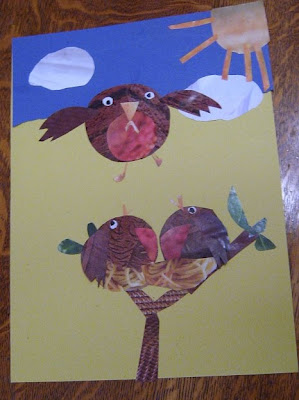
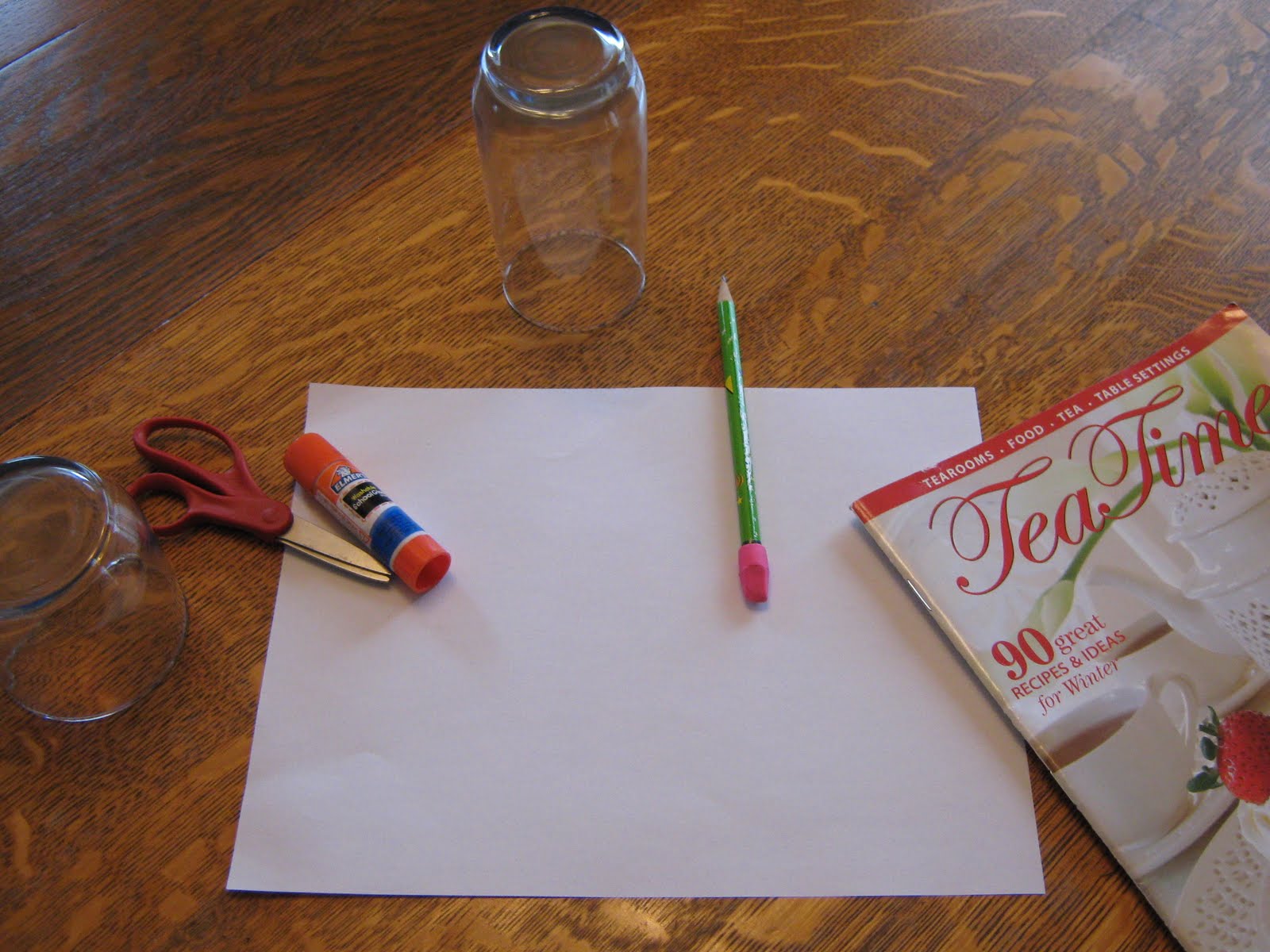 C (age 4), wanted to cut, last night, and E (age 6) wanted to make a craft with robins. So, I grabbed an old magazine, and we set to work on a collage.
I pulled out a few pages for C to cut away on independently, while E, and I flipped through the rest of the magazine, looking for the right colors, and tracing out shapes, for her robins.
It was fun to find the colors for feathers in pieces of cake, and teapots...

...yellow for beaks in bowls of sherbet...

...and to envision noodle nests, in a place mat tree.

I traced shapes out, for her to cut...

...then laid out the pieces out, to suggest the picture...

....for her to move over, and glue onto construction paper.

She was pretty pleased with the results, and has now decided maybe she will grow up to be an artist, instead of a hairdresser in Paris (a career option, I'm sorry to say, she picked up from watching Pee-Wee's Big Adventure).
It's great to be a homeschooler.
Subscribe to:
Posts (Atom)


