Sunday, March 18, 2012

Easter Kick Off - The Good Shepherd Activity

A (age 11), kicked off our Easter fun this afternoon, by preparing the salt dough tomb for our Resurrection scene.


It's still cooling and hardening, after spending part of the afternoon in the oven, and won't be ready to be set up with the Little People from our Nativity set until tomorrow.


In the meantime, I pulled out our cardboard building set, and had the children create a pen...


...around 100 sheep I printed across three pages, and T numbered for me. I forget where I found the sheep template, but almost any sheep coloring sheet, printed in thumbprint size, would do.


I actually printed two sets of 100 sheep - one set, numbered in black, and placed inside the pen, to work as "stalls", and one cut apart, and numbered in blue...
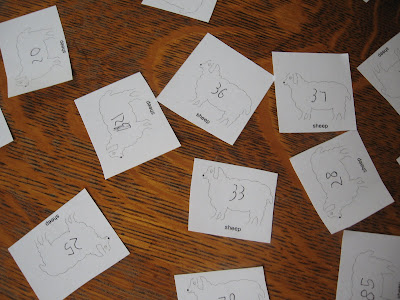

...to be spread out in the "fields" outside the pen.


Then, the girls worked as shepherds, bringing in the flock, making sure there was one matching sheep for each "stall" inside the pen...


While they sorted and counted the sheep, I set about mixing up a batch of sheep cookies, to go along with a follow up story...


...just not the story I had in mind. When I set up the activity, I was thinking of Jon and the Little Lost Lamb, the Arch book I had as a child. It tells the parable of the 99 and 1 lost sheep from Luke 15: 1-7.


So, before I slipped away to make the cookies, I swiped one of the sheep from the table, and hid it nearby, for the girls to search for...


...once their sorting was complete, and they realized one sheep was missing.


As it turns out, The Good Shepherd Arch book we have now tells the parable of the Good Shepherd and the Sheep Gate from John 10:1-18, instead.


But, The Good Shepherd works just as well with the pen, and the sheep (and the cookies), and has an even better lead into Easter, since the Good Shepherd lays down his life for the sheep. So, even though it wasn't the lesson I was planning - it was all Good in the end.

It's great to be a homeschooler.

Saturday, March 17, 2012

Motorized Rainbow Spinners - More Fun With Light and Color for Children


While we still had all the bits and bobs of our old electrical science kits out, I thought the younger girls might enjoy some more rainbow themed play. This time, instead of bending white light into a rainbow of colors, our objective was to blend them back together.

I printed an already colored rainbow spinner pattern from Ben's Coloring Pages, and glued it to a thin piece of cardboard before cutting it out...


...and poking a nail sized hole in the center, to slip onto the spinning arm of our hobby motor, topped with a little propeller cap, to keep the disk from flying off.

The girls helped me attach the motor to our battery pack (the hobby motor, wires with clips, and battery holder can all be purchased through Amazon, or at most Radio Shacks or hobby stores fairly inexpensively, though as I said, ours are all leftovers from old science kits, which in some cases can be even more cost effective).


We watched as the colors on our spinning disk...


...started to blend together...


...and then disappear into a creamy white.


The girls discovered they could bring the colors back by carefully (keeping away from the sharp cardboard edge) touching the top of the disk, so it wobbled. I couldn't catch it on camera, of course, but there was an added optical illusion of a rainbow outline around the girls fingers, for those of us looking at the spinning disk they were touching.


It kept the girls (ages 5 and 7) entertained for quite some time, until the spinning bar from the motor wore too large a hole in the wobbling cardboard, and the disk wouldn't spin anymore. Then, we made a few more disks, each with only two colors...


...which instead of disappearing when the disk started to spin, turned into a third color altogether.


It's great to be a homeschooler.

Friday, March 16, 2012

Can Butter Conduct Electricity? And Other Questions For Children From Burkina Faso

Turning back to our study of Africa, the children and I, joined by the Man of the House at lunchtime and in the evening, spent most or our day yesterday, lost in the cities and deserts of Burkina Faso, with Stephen Davies' teen thriller Outlaw.

In fact, we found the fast paced, action adventure trek through the political underbelly of the small west African nation is so riveting, I think we might actually have finished the entire two hundred and eighty some pages in a marathon family read-aloud session, if we hadn't gotten distracted midway through by a science experiment, we just had to try.


Jake, the 15 year old protagonist of the story, finds himself kidnapped, along with his 13 year old sister Kas, and hauled out to a remote location in the desert. Along the way, he manages to make a few frantic calls to his father, the British ambassador, before his cell battery goes dead. Out of cell range, but hoping for a rescue, the teen charges his phone using a couple of batteries from a flashlight, and some goat's milk butter.

In a "what is fact and what is fiction" section at the back of the book, that made my homeschool heart happy, the author sights a YouTube video on "How to Charge an Ipod with Batteries and Whipped Cream", as inspiration for the stunt.

We looked up the video, and then decided to do a little experimenting ourselves. In the book, Jake simply lays the batteries together on a metal plate (he'd been given to eat on)...


...shakes his goat milk in a handy gourd, until it turns into butter, slathers the butter over the batteries, and sticks his charger cord, connected to the his phone, right into the butter.


The YouTube video works pretty well the same way, except using whipped cream instead of butter, and a ceramic plate. I didn't want to risk a perfectly good charger cord with destruction by butter, so instead pulled out the odd bits and bobs we have left from old science kits, and chose a little motor, inserting the terminals right into the butter.

Nothing happened, even when we tried upping the juice with four AAs in our Leapster's battery pack.


We remembered we've had luck in the past, running electrical current through a bit of playdough, so we set up a control experiment, using playdough to complete a circuit between our battery pack and a small, but loud, buzzer. The playdough worked perfectly.


The butter however did not. We tried it with salted, unsalted, melted, and hard butter, and on a nonconducting plate...


...verses a conducting spoon. And while the spoon alone could be used to complete our circuit, we just couldn't get the butter (or whipped cream, which we also tried) to conduct a current.


The closest we came to the feat of the book, was using buttermilk (left over from our Irish soda bread), with about tablespoon of salt added in.


Jake's goat butter might have been more buttermilk than butter, but there's no mention of him adding any salt, so we're filing that page of the book under pure, but really fun, fiction, and moving on. The rest of the story is filled with enough techno babble, teen terminology and African geo-politics to keep us happily busy, at least until we can get to the library for the next Stephen Davies teen novel - which I believe is set in Mali.


It's great to be a homeschooler.

Linked with:


and

Science Sunday

Wednesday, March 14, 2012

Pi Day Activities

Today, while the younger girls busied themselves making...


...Lois Ehlert inspired...


...playdough pies (using our sweet scented Valentine's playdough)...


...the older children got to work...


...transforming chocolate sugar cookie dough...


...into Pi...


...to go along with Cindy Neuschwander's Pi themed math adventure...


But first, we watched the Cyberchase "Spheres of Fears" episode at PBS-Kids, and a quick Brainpop "Pi" feature, which is free today, even if you don't have a subscription. How terrific is that?

It's great to be a homeschooler.

Tuesday, March 13, 2012

Irish Soda Bread


It turned out two of the books we checked out for Saint Patrick's Day, Ann Heinrichs' Saint Patrick's Day, that I mentioned already...


...and Happy St. Patrick's Day by Abbie Mercer, a very similar, simple, non-fiction, from past-to-present look at the holiday for children...


...both contain recipes for Irish soda bread. Heinrich's recipe is a sweet version, with raisins added, while Mercer's book includes the simple, straightforward, 4 ingredient (flour, baking soda, salt, and buttermilk), traditional version, meant to be eaten as an everyday bread.

We opted for Mercer's recipe, and followed her instructions for mixing the dough by hand...


...at least C (age 5) did. D (age 9) declared it too messy, A (age 11) claimed flour dries the hands, and E (age 7) thought the buttermilk smelled bad and didn't want to touch it. The older two children were out at the time, or I'm sure they would have had some excuse to keep their hands out of the dough, as well.


C, however, had a great time, mixing and kneading the dough, and helping to shape it into a ball on the cookie sheet, for me to slash open with a couple of "X" shaped cuts.

We enjoyed the bread (which really tastes more like a biscuit), with hearty bowls of Irish stew - or vegetable beef soup, anyway, about as close as we're going to get to Irish stew anytime soon, while watching Nature's "Ireland" episode on pbs.org, about the wildlife and natural wonders of the country.


I thought it would all make for a very nice, geography themed, lunch. But, for the sake of "keeping it real", I should mention, that neither the bread, nor the video received rave reviews from the children. Though, we did enjoy learning about a few new-to-us animals like stoats and gannets, that will be worth further study. And, the children agreed that soda bread, while not their favorite food, isn't too bad with the addition of a little jam or honey. So much for our Irish roots.

It's great to be a homeschooler.

Linked with Watcha Making Wednesday at the Ramblings and Adventures of a S.A.H.M.

and

The Geography and Hisory link-up hosted by All Things Beautiful, every Thursday.

Monday, March 12, 2012

Shamrock Trinity Table Runner Craft


I made up a batch of shamrock cookies to go along with our reading of Ann Heinrich's simple, holiday text for Saint Patrick's Day.


And, while the cookies were baking, I put the older children to work, decorating a table runner, focusing in on the legend of Saint Patrick using the shamrock to explain the trinity - that just as the shamrock has three leaves growing off of one stem, the Father, Son and Holy Spirit are all one God.


First off, I traced out a pattern for heart shaped leaves and a free-handed stem, on the back of a cereal box, as well as a complete shamrock using the same heart shaped cutter (I washed it, before making the cookies).


Then, I found seven verses that each refer to all three aspects of the Trinity (copied here from carm.org):

Matt. 3:16-17, "And after being baptized, Jesus went up immediately from the water; and behold, the heavens were opened, and he saw the Spirit of God descending as a dove, and coming upon Him, 17and behold, a voice out of the heavens, saying, “This is My beloved Son, in whom I am well-pleased.”

Matt. 28:19, "Go therefore and make disciples of all the nations, baptizing them in the name of the Father and the Son and the Holy Spirit,"

1 Cor. 12:4-6, "Now there are varieties of gifts, but the same Spirit. 5And there are varieties of ministries, and the same Lord. 6And there are varieties of effects, but the same God who works all things in all persons."

2 Cor. 13:14, "The grace of the Lord Jesus Christ, and the love of God, and the fellowship of the Holy Spirit, be with you all."

Eph. 4:4-6, "There is one body and one Spirit, just as also you were called in one hope of your calling; 5one Lord, one faith, one baptism, 6one God and Father of all who is over all and through all and in all."

1 Pet. 1:2, "according to the foreknowledge of God the Father, by the sanctifying work of the Spirit, that you may obey Jesus Christ and be sprinkled with His blood: May grace and peace be yours in fullest measure."

Jude 20-21, "But you, beloved, building yourselves up on your most holy faith; praying in the Holy Spirit; 21keep yourselves in the love of God, waiting anxiously for the mercy of our Lord Jesus Christ to eternal life."


I traced out three hearts, and one stem for each verse, on green construction paper. I printed the verse references on the stems, while the verses were divided amongst the hearts, so each of the three hearts per verse, had a part of the verse dealing with a different aspect of the Trinity - Father, Son, or Holy Spirit.


After I cut the hearts and stems out, I flipped the hearts over and wrote which part of the Trinity each heart dealt with. Then, I spread them out on a piece of butcher paper I had run down the center of the table, like a table runner...


...and traced seven (one for each verse) shamrocks on.


Using their Bibles, and the references written on each stem...

...the children had to locate, sort out, and glue the leaves on each shamrock to unscramble the verses...


...making for a festive decoration for our story time, and adding some depth to the legend of Saint Patrick.


It's great to be a homeschooler.

Linked with Bible Alive! Tuesday hosted by The Fantastic Five.