Thursday, March 28, 2019

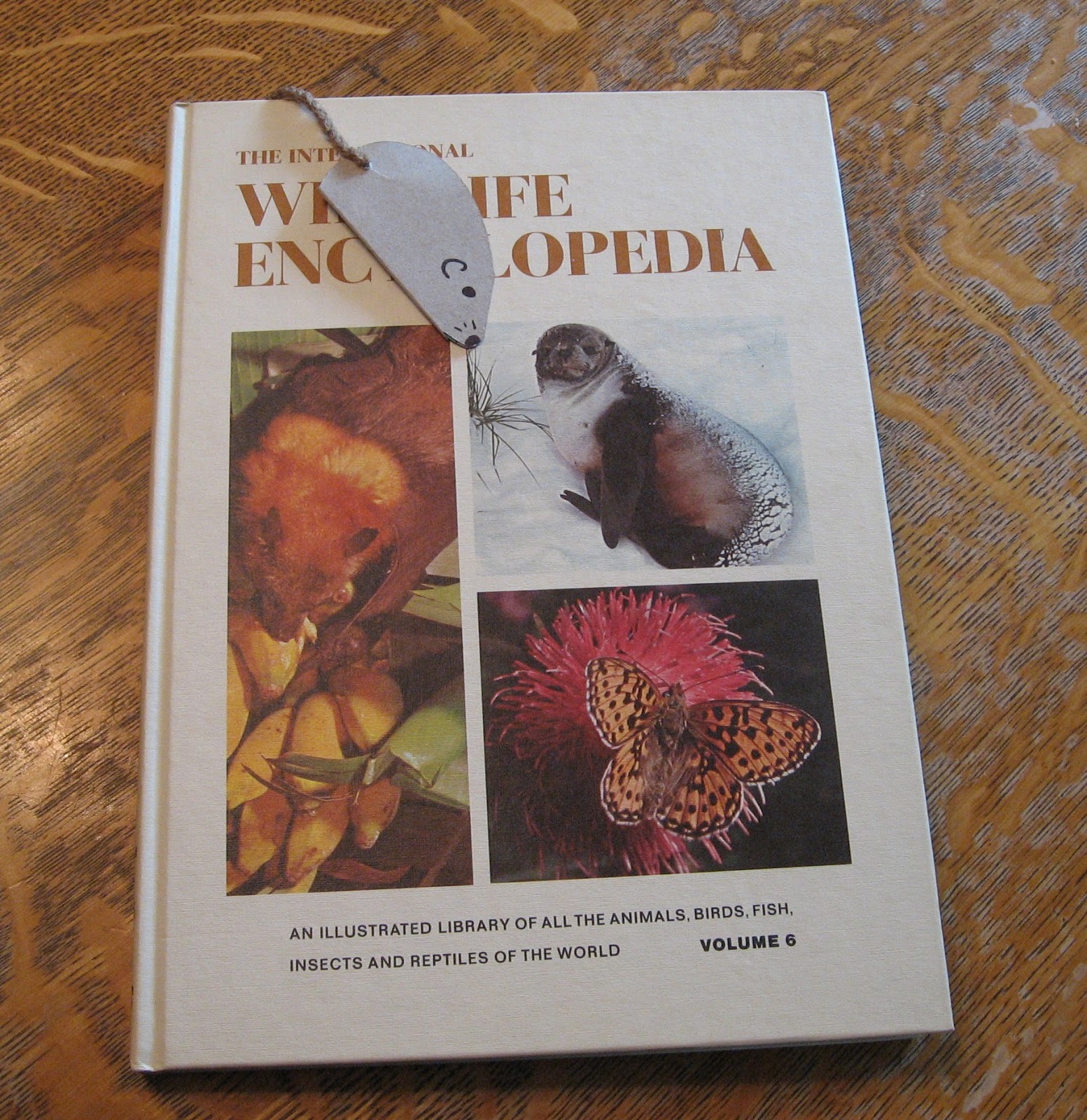
The International Wildlife Encyclopedia - A Surprise Hit for Middle and High School Science

We finished up the science books we've been working through this year, early. Instead of rushing out in search of something new, I gave the younger children (ages 12-16) a volume of Marshall Cavendish's "International Wildlife Encyclopedias", and ask them each to try reading about one animal a day, as part of our new "use what's already on our shelves" initiative.

I can't remember when we got the set, or where it came from - some library sale, the grandparents, or a spring cleaning neighbor, maybe.  It's been on our bookshelves for a long time.  We've used a volume, once or twice, for refence (like the time we had a vole in our window well)…


… but I never would have thought to hand them out as reading material if we hadn't been trying to deliberately use books from our own bookshelves.  And, what a loss that would have been.  It turns out the set is huge hit.

I was thinking it might make a good filler until summer break, and sort of keep science going in a vague way.  But, the volumes are packed with information, and a good dose of history, anthropology and geography on top of basic biology.  And, they're  written right at the perfect middle school/high school level to really engage all three of the kids.  They've turned out to be so much more interesting to the children than the science books they dutifully (and willingly) read, but then quickly forgot, already this year.

Not only have they happily been reading about a new animal each day, they're sharing with each other what they've read, in an enthusiastic, "hey, look at this!" kind of way.

I could only dream that our other science texts would spur the kinds of discussion and additional research that these plain, old (literally old, they were published in 1969) encyclopedias have done.

It's great to be a homeschooler.

Tuesday, March 26, 2019

Homeschooling the Teen Years - Taking the Next-Gen Accuplacer Reading and Writing Tests

D (age 16) finally got around to taking the reading and writing portions of the Accuplacer (college entrance exam) test, yesterday.

As you may or may not remember, he took the math section at the end of January, and had planned to wait about a week and then take the reading and writing sections.  Winter hit with a vengeance right after that though, and we didn't want to have to add the worry of whether we could make it to our testing appointment to the stress of the test. So, we waited until our roads had completely thawed out to schedule the final sections.

But really, there is no stress to this particular test - or at least there shouldn't be.  The Accuplacer is a placement exam, the reading and writing sections are designed to indicate if a student is reading, and prepared to write at a college level.  If they are not ready, you don't want them in college classes - they will fail.  If they are ready, it will show on the test (barring any type of serious disability that makes testing itself difficult, and then allowances should be made through your local testing center).

The Next-Generation version of the Accuplacer doesn't even include an essay section (the old Accuplacer required an essay).

That means that basically it's just a multiple choice, reading comprehension and basic grammar (read this section and correct the errors) type of test.  And from our experience, it seems that the equivalent of an 8th grade education is what is currently passing for "college ready" in our country.  So, really don't stress.

Not to mention, that on the off chance that a student crashes and burns on their test day, this is one of those tests that can be taken as many times as you like (for a small fee of around $10/section), and only the most recent score counts.

The College Board site (where you sign up for the SAT's) and the Mometrix test prep site have plenty of additional information about the how, when, where and why's of the test.  They even offer study guides - though if you take my advice you'll skip that in favor of an honest assessment of where your student stands.

It's great to be a homeschooler.

Monday, March 25, 2019

Homeschooling the Teen Years - Creating a High School Diploma


I had some time this weekend, so I decided to print-up and add the finishing touches to A(age 18)'s "official" high school diploma.  She has one coming from our local homeschool association, ordered from an print company, that we'll present to her at the homeschool graduation, but this is the one we'll use in our private, home ceremony, and have notarized (which is why it isn't signed yet) to present to her dual-enrollment college before they can issue her an associates degree for her credits earned there.

I had really wanted to have some fun with our home diploma...


… but in the end, I decided that since it's going to the college, and since we'd like them to take us seriously, we'd better be good and play it straight.  Sigh.

I searched "homeschool high school diplomas" and grabbed one from images that I liked, to use as a template.  Then, with my own high school and college diplomas as a guide, I cut and pasted things around in paint, and typed in our personal information in a font as close to the template font as I could find (there are plenty to choose from in paint).  I would have added a verse to the bottom, but the template I chose already had the one I wanted (Col. 3:23), so I didn't even have to do that.

You can order a diploma, pre-printed and personalized, or you can create one completely from scratch.  I liked having the copy from images as a template just to keep size and placement in mind, and so I didn't have to look up how to curve words, but it could certainly be done.

You want it to state what it is, to have the date of graduation, the graduate's name, your homeschool name, if you have one (I simply put from the J-- Family Homeschool, since we don't have an official school name), and that it certifies the graduate has completed the study required (by your homeschool) to graduate from high school.  I also added our city and state.  Again, you can look back at your own diploma, or check for examples online, just to make sure you don't miss any details.

You can also buy special, heavy-weight, paper to print your diploma on from just about any office supply store.  I tea dyed a light weight piece of card stock (I think it was part of the packaging from one of the boys' dress shirts) for G (age 19)'s diploma, when it was her turn...


… but this time, I opted for plain old typing paper (though I did add a gold foil seal sticker for an aesthetic touch).  As to size, all of our other diplomas are about 5''x7'', but this time I chose 8.5'' x11'', to leave plenty of room for the foil seal, and the notary stamp (which, as I mentioned, the college wants to see in order to count the diploma as official).

While I was ordering the seal stickers from Amazon, I also ordered a diploma case (I like the ones that come with a plastic sheet to cover the diploma), and a "grad" tiara  (since A hates the mortarboard, and I didn't get to have any fun with the diploma).  It ended up coming with a grad sash and eight grad party pins too...


… so we're all set!

It's great to be a homeschooler.

Thursday, March 21, 2019

Homeschooling the Teen Years - How to Pay for College, Part 2


Once you and your future college student have pursued all of the standard avenues for funding tuition and other collegiate expenses, it can be tempting to think about returning to the work-force yourself, to help out.

The majority of homeschooling families survive on a single income.  That makes sense, as homeschooling is a full-time job in and of itself.  That also means there is a potential source of additional income lying dormant in your home.  If one parent is already able to support all of the household expenses, then theoretically a second income could be used completely for outside expenses (such as tuition for your children).

Of course that's not entirely true, because going back to work comes with expenses of its own in clothing, travel, tools and the like.  I've dipped my toe back into the workforce waters a few times in the last few years - once as a para-professional in a school, once as a temporary worker closing a local branch of bankrupting big box store (a fascinating "Americana" experience), and briefly herding toddlers at a daycare connected to the college where the kids have been dual-enrolling.  Each time I ended up spending almost as much as I earned back into the job.

Mind you, I wasn't making much to begin with.

One of the shocking things to keep in mind, if you are considering going back to work, is how little your years away will be worth to potential employers.  That might be a topic for a future post.

The biggest problem I encountered with working though, apart from discovering how comfortable with "traditional" roles my formerly egalitarian husband had become, was that it was detrimental to the schoolwork the children still at home.  I know some people are able to pull off working and homeschooling at the same time.  I am not one of them.  So, this will probably not be an option for us this time around - maybe when our youngest is applying to college (if I can still walk without a cane by then).

However, if you are going to try heading back into the workforce to help pay expenses for your student, and if you live close enough to their college or university of choice, you might begin your job search there.  Some schools offer a tuition waiver for the families of their workers (even if you're a janitor or cafeteria server).  My mother-in-law went to work in the admissions office of a local college when her two were in high school, and was able to offer them free tuition without touching her take-home pay.

Not all schools offer this benefit, but it's worth checking out benefit packages if you're thinking about heading back to work anyway.

It's great to be a homeschooler.

Monday, March 18, 2019

Homeschooling the Teen Years - Don't Believe Everything You Read on a College Website


For those of us who attended universities during happy days of growth and expansion, the shifting sand of the current collegiate landscape can be startling.

When Moody Bible Institute closed its Spokane campus last year, we felt like we'd dodged a bullet. T(age 21) had seriously considered one of the programs they offered in Spokane.

When we asked, during the parent orientation day at his current university, about the debate team they had touted on their website (which offered scholarships for participants), we were sad to learn it had been discontinued more than a year before when the professor who had been heading it up left the school.

When the same school announced sweeping cuts to majors this spring, including one that A(age 18) had not only considered, but applied and been accepted to, we counted ourselves fortunate that T's program was left intact (for now).  But, we're formulating a back-up plan.

When A considered her second local choice, a program offered by one of the state schools through a local extension office here in town, I was nervous when a recruiter from the school told us at a college fair that she'd heard rumor the local program was going to be shut-down.  According to the website, everything was fine for that program and another being offered here in town with face-to-face classes.

I called the school and spoke to admissions officers, secretaries, professors and administrators.  Some assured me all was well.  Others were unsure or unable to share what they "knew".  As spring approached, the two programs remained listed on the school's website.  We worried less, figuring the rumors had been false.

When A settled on one of the two programs as the most practical for next year (though she hasn't completely given up on the concept of a gap year) I took a quick peek at the fall schedule to see which classes were being offered locally fall semester.  There weren't any listed for either of the programs.

I called the school again (after A emailed them and waited a solid week for a reply), and discovered that one of the programs has not been offered locally in over a year.  The other is supposedly still being offered.  Needless to say, we set up a meeting with the program advisor, and started formulating yet another back-up plan.

My point with all of this is that since we, as homeschool parents, are also our children's guidance counselors, it's important to stay as on top of the changes coming to the colleges our students are considering (it's not always easy), to be ready with back-up plans (and back-ups for the back-ups), and to never (NEVER) take a college website at face value.  Check, check and double-check every fact you read.

It's great (if sometimes exhausting) to be a homeschooler.

Thursday, March 14, 2019

Homeschooling with Teens - Books to Movies: Mary Poppins Returns

I had a chance to watch Disney's Mary Poppins Returns with four of the kids today - my two oldest (ages 19 and 21) and my two youngest (ages 12 and 14).


Even though we'd read that the film is not really a literary adaptation of P.L. Traver's work, the younger girls and I read through the second book from the Mary Poppins series, earlier in the week, just in case...


… and I'm so glad we did.  The magical nanny from the books is quite a bit different than one Julie Andrews brought to life in the original Disney classic (more like Nanny McPhee with a dash of Mrs. Piggle-Wiggle).  Somehow though the film-makers managed to capture quite a lot of the tone and content of Traver's story, while still creating what truly feels like a sequel to the first film.

I didn't have high hopes going in.  The cast looked good with Emily Blunt (we loved her in The Devil Wears Prada), Emily Mortimer (a favorite of ours from The Kid), Lin-Manuel Miranda (E is a huge Hamilton fan), Colin Firth (Mr. Darcey!), not to mention Dick Van Dyke, Julie Walters, Angela Lansbury, and Meryl Streep.  I really thought Disney would ruin it though, but they didn't.

It's clean, family friendly, upbeat (even if the opening scenes did cause my oldest to claim he'd gotten soda fizz in his eyes), beautifully filmed, with more than a couple catchy tunes, and just enough of the book to keep it interesting and of the film to keep it light and nostalgically entertaining.

It's one we'll watch again.

Wednesday, March 13, 2019

Homeschooling With Teens - Sabaton Has a History Channel!!!


I posted a few weeks ago about the Swedish metal band's history themed songs.  Then, a week or so ago one of my local homeschooling friends sent us a link to a video announcing a new YouTube history channel exploring all the history behind the songs.


We finally got around to watching the first of the series (on the battle of Wizna) this morning, and loved it.  It's extremely well done.

The series is hosted by Indy Neidell, a Texas born historian now living in Sweden, who has a couple of very interesting sounding YouTube channels of his own - one walking week by week through the events of WWI and another exploring the events of WWII.  I'm looking forward to checking them out with the kids, as well.  Please keep in mind though, that I currently know almost nothing about him, so if you check out his channels proceed with caution and all due discretion, as with anything online.

It's great to be a homeschooler.