Wednesday, April 22, 2015

Building a Simple Solar Battery Charger - Polarity Matters!


Definition of Polarity (from the Kids.Net.Au Dictionary):

  1. a relation between two opposite attributes or tendencies; "he viewed it as a balanced polarity between good and evil"
  2. having an indicated pole (as the distinction between positive and negative electric charges); "he got the polarity of the battery reversed"; "charges of opposite sign"
So, it turns out charging a single AA rechargeable (NiMH) battery with a small (1V) solar cell is both incredibly simple, and incredibly complicated.

As were really just out to power a solar scribble-bot on a cloudy day, we opted to keep it simple.

The main thing to keep in mind is that polarity matters.  POLARITY MATTERS!!! 

I know this might sound like a bit of a "duh".  I mean, we've all watched The Magic School Bus "Get's Charged" often enough to know that with DC power (like with the battery) those little electrons move in a single direction through the wires, right?

But, after hooking and unhooking the batteries and solar panel from various hobby motors - it becomes easy to forget.  Polarity only matters with hobby motors if you care which way the axle is spinning.  Since we didn't care, we didn't really pay attention to which wire was positive, and which was negative.  So, when we went to charge our nearly dead battery with the solar cell, we didn't even think to check if the solar panel had positively and negatively marked connections (which you can see from the top of the page - it did).

Needless to say, we had the battery hooked up incorrectly, (-) to (+) and (+) to (-) when we made our first solar charging attempt, yesterday.  This is a good way to damage a battery, and a solar panel.


Today, with a freshly emptied battery (that little fan finally quit turning), we tried again, this time taping one wire to the negative side of the battery, and connecting the other end to the negative post of the solar cell, with the positive side of the battery wired to the positive post.


We left our "charger" out in the sun for a few hours, while we headed off to a homeschool park day.  When we returned, we checked the battery by connecting it to the fan, which started to turn...slowly...and only for a few minutes - but still!  We would have loved to have kept our battery charging for longer, but just as the fan stopped turning...


...the sun went behind a cloud, which was joined by another cloud, and another, and...


...I think it might be a few days before we are attempting any more solar projects.  Cloud study, anyone?


If you have sunnier skies, and would like to build a slightly more "official" solar charger (maybe one with a diode, that would keep the solar panel from sucking the power back out the battery when the sun disappears) for a science fair or teenage science project, I'd suggest checking out the instructions for the DIY $10 USB Solar Emergency Charger over at the Survival Prepper Joe site (love that name!).

Of course, if you have $10 to spare, you might want to skip the survival kit (it's a slooooow charge at its best), and put your money where it can do some real (and tax deductible) good - providing full sized solar panels and batteries for college students in Zimbabwe; where, I'm told, the sun is usually shining.  Help "Flip the Switch" on in Bulawayo.


The Saga of the Solar-Bot Continues - Solar Chargers and "Making it Real"


We spent pretty much all day yesterday, trying to drain the power from a couple of batteries, so we could try recharging them with our small solar panel, in the hopes of powering our solar scribble-bot more efficiently.

Naturally, in order to charge a battery, we needed a battery without a charge.  We also wanted to get a feel for how long a fully charged batter could run one of our hobby motors, so we could compare it to how long it ran once charged with the solar panel.  To accomplish this goal, we set up a couple of batteries (it never hurts to have a back-up, right?) in a little makeshift timing station.


Basically, we just taped our alligator clipped wires to either end of our batteries, and then shoved the batteries down over upside down plastic glasses, to tilt the alligator clips, and keep them in contact with the batteries (fancy, I know, but it worked).

We attached the other end of the wires to our motors, mounted in paper cups, and topped with doohickies from an old science kit (in this case a fan, and an axle) to allow us to easily see that the motors were running.

Then, we started a stopwatch, and waited.

Apparently the commercials with the drumming bunny aren't far off though, because our little fan and axle just kept going, and going, and...well, you know.  Finally, about mid-afternoon, it dawned on me to pull one of the batteries from our Leapster (those are always dead), and charge that.

We took our solar panel, and taped up battery, outside.  After testing that we had our solar panel positioned correctly, by seeing if it could run one of our hobby motors...


 ...we hooked it up to the battery, and left it to charge in the sun for a couple of hours.


We checked the battery in our electric charger (which has a nice indicator light) before, and after charging it in the sun.  Before we charged it, it had showed one "bar of power" indicating a very low charge. After we removed it from the solar panel...


...well, it was exactly the same.

Leaving us, once again, with a number of questions to answers.
  • Can you really charge a battery by just attaching it directly to a solar panel?
  • Is our solar panel powerful enough for a AA battery?
  • How can we tell when and if the solar panel is sending power to the battery?
  • Do we need a diode to stop the power from draining back out of the battery during charging?
  • Do we even know what a diode is, and do we have one rattling about somewhere in one of our old science kits?
Clearly, we have more work, and research to do.  In the meantime, you might consider celebrating Earth Day today, by reading up on a team of students from Pennsylvania's Messiah Collage.

Photo Credit

They've completed their solar energy research, and are ready to apply, and share what they've learned in the real world, by traveling to Zimbabwe - where the sunshine is far more reliable than the local power grid.  They hope to install a much needed solar array to provide back-up power for a computer lab, and library at the Theological College of Zimbabwe in Bulawayo.


As the students state in the video above, they have raised the funds for their travel expenses, and are now working toward fully funding the equipment end of the project.

Playing with mini-solar panels and scribble-bots is a lot of fun, but if you're looking for an Earth Day project to "make it real" this year, you might consider popping over to their RocketHub project page to learn more, and maybe even donate $10 dollars or so, to help the earth - and a few of the people living on it, at the same time.

Imagine being a college student in a country where the electricity goes off several times throughout the day, often for up to 2 or 3 hours.That's life for men and women enrolled at the Theological College of Zimbabwe (TCZ) in Bulawayo. But it doesn't have to be this way.

Text and Photo Credit

Monday, April 20, 2015

The Saga of a Solar Scribble-bot


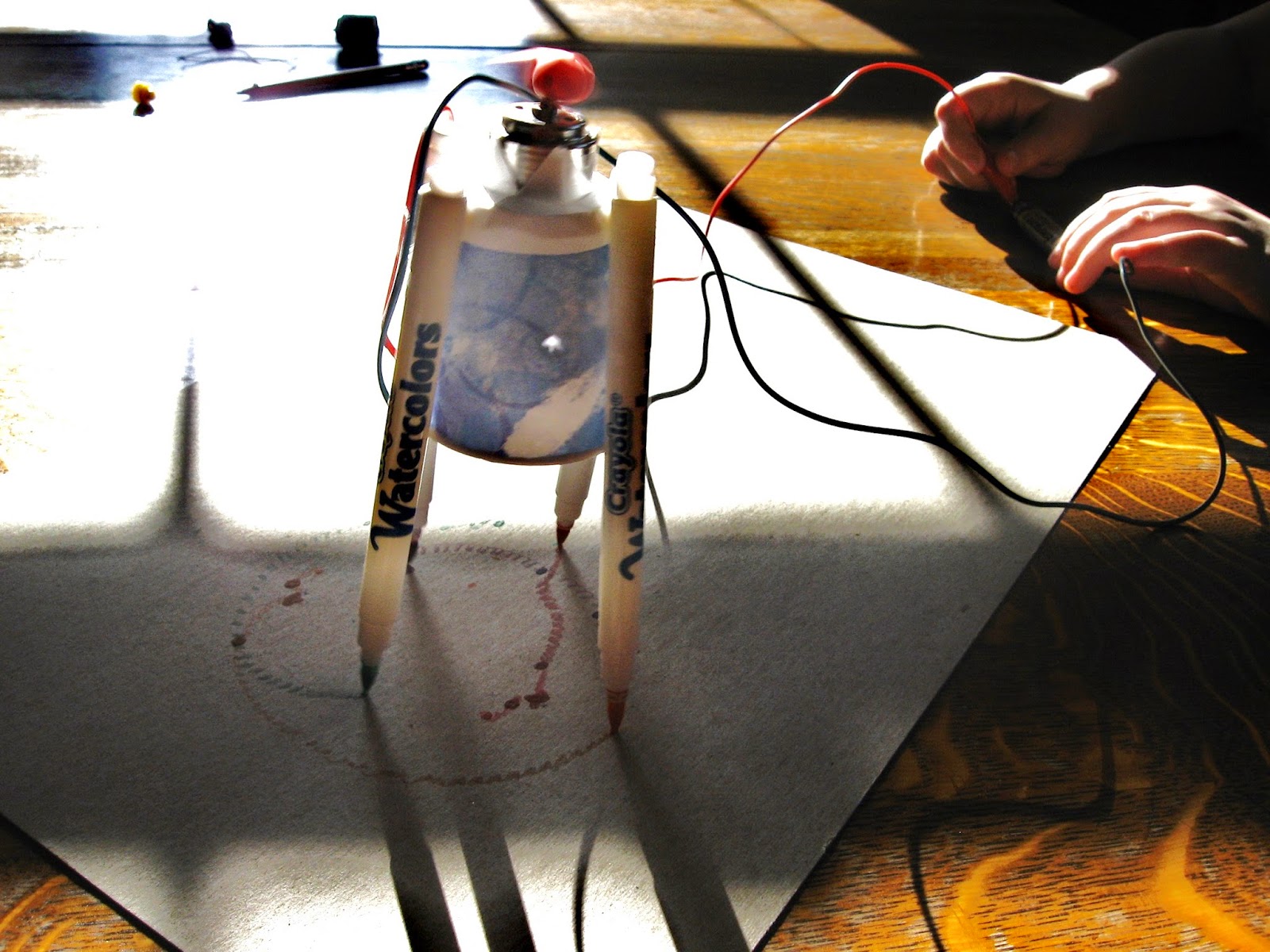
With Earth Day coming up this week, we decided it might be fun to give a scribble-bot solar make-over.

We had an old solar cell left over from a Klutz Solar Car book, as well as the alligator clipped wires...


...and all the various hobby motors, that we had picked up for our battle-bots.


The solar cell had screws on the back...


...to clip the wires to, making it very easy to attach to one of the motors, for a test run.


We started out with our smallest offset motor, stuck in a small paper cup.  The motor worked with the solar cell.  But, we quickly decided it was not strong enough to move the cup as much as we would need for a full out scribble-bot.  Instead, we switched over to one of our standard hobby motors (like the one that came originally with the solar cell in the Klutz book), offset with a pencil eraser, before adding the markers, or in this case - the Crayola No-Drip Watercolor Paint Brushes (which happen to be ideal for scribblebots) to the cup.


So far, it was all just standard scribblebot design, like you can find on many different websites.  Working with the solar cell however, added some unique challenges.

First off, we couldn't get the larger motor to run, even when it appeared the solar cell was in the sunlight.


We tried kick-starting the motor by spinning the eraser, manually, a few times.


Then, just to be safe, we tested the motor with a AA battery, to make sure it was functioning - which it was.


Finally, we took the whole thing outside, and tried turning the solar cell until it was casting the longest shadow possible.  At first, there was nothing, but after one more try at kick-starting the motor with a spin of the eraser...


...we had success.  Or, at least something close to success.  The motor was moving, but slower than it did when we tested it with a battery, producing a stilted, straight line kind of scribble...


...instead of the exciting curly-ques we could get with battery power.


Returning to the drawing board, we switched back to the smaller motor.  Which, while not powerful, did spin quickly when powered by the solar cell.  To make up for the loss in power, we lightened our design, using the top of a plastic egg shell (left over from our insect eye glasses), and mini-markers in place of the paper cup, and paint brushes.

Armed with our new knowledge of the importance of careful positioning of the solar cell to catch the optimum amount of sunlight, we were able to move back inside...


...with positive results.  We still weren't getting quite the scribble power we wanted, but we were getting closer...


...and the girls were completely fascinated by how instantly the motor stopped and started, as they blocked...


...and unblocked the sun from the solar cell.


The sun was sinking quickly though, so we had to pack it in for the evening, leaving us with another problem to address.  Namely, how do we store solar power to use once the sun goes down?

We hope to find out, tomorrow.

Saturday, April 18, 2015

Crayola Watercolor Paints, Drip or No-Drip - Review


The girls and I had the paints back out today, to brighten up a gloomy Saturday afternoon (spring rain turned back into snow). Sigh.

Still we had the Bee Movie to watch (again), and new paints to try - Crayola's No-Drip Watercolors.  The girls (ages 8 and 10) had liked the No-Mess Paint Brush Pens so well, I thought we'd give another "mess free" product a try.


The package promised no drips, and no spills, which the paints delivered.  You don't even need a cup of water.  But, they also turned out to be less than fun - at least according to my two.


The brushes were hard, like marker tips, and didn't allow the paint to wash over the paper the way the girls wanted.  And, while it was easy to get the paint onto the brush, it was really hard to get back off.  Typical of Crayola though, the colors were bright and clear, just like the regular Crayola watercolors the girls love.

And luckily, we had some of those, too.

Thursday, April 16, 2015

Plastic Egg Compound Insect Eye Glasses


No impromptu honey bee study would be complete without a quick look at compound eyes.  I thought, briefly, about running into town to see if I could find a pair of "bee" glasses at a toy store, but we had company coming in, and T (age 17) had a midterm scheduled, with our associate pastor coming over to proctor (meaning I had a house to clean, and thank you cookies to bake), so I opted for something the younger children and I could put together quickly.

After fumbling around our craft closet, we came across a couple of plastic eggs (this is a great time of year to pick up a package or two, on clearance, to use for projects just like this). We pulled the bottoms off of two of them, and I (it takes a bit of hand strength) poked a bunch of holes in them with a thumbtack. 


Bees' eyes are made up of thousands of tiny lenses, giving them a mosaic-type sight, much like looking through the holes in the eggs.


When we were satisfied with the number of holes punched, we taped the eggs together, glasses style, with two pieces of clear tape, sticky sides together, for a bridge...


...and a piece of elastic string tied through holes near the outside edge, to hold them on.


They aren't a perfect representation of compound eyes, but they are pretty neat to look through, and quick to make.  The only thing that might make them better would be using red colored eggs.  Apparently, honey bees don't see red, and I think looking though holes in red eggs might make it hard for the children to see red, too - that would be a nice effect.

If you're interested, you can find out more about honey bees, their vision, and compound eyes at  http://ag.arizona.edu/pubs/insects/ahb/inf2.html.

Wednesday, April 15, 2015

Collecting Pollen With Static Electricity


One of the interesting facts we read about bees, this week, is that the little hairs on their bodies build up a static electric charge, that attracts pollen to them, as they fly over, and land on flowers.


That sounded like something we needed to try out for ourselves. C (age 8) took a balloon outside, rubbed it on her head (to produce a static charge), and then passed it over a dandelion (coming close to the flower, but not touching it).


And, sure enough...


...it worked.  There was pollen on the balloon.


I don't know about you, but we thought it was pretty cool.

Tuesday, April 14, 2015

The Evolution of a Zoob Honey Bee


The creation above was D(age12)'s contribution to our honeybee study, yesterday.  It started out in the morning as a Kafkaesque combination of a Zoob-man meets insect.


Then, after some reading on insects, and bees in particular, it gained a couple of legs, and an abdomen as well as a thorax...


...finally morphing, by late afternoon, into a full blown, if slightly cumbersome, honey bee...


...all ready to be photographed, and labelled in Paint.  


I was very grateful for the entire process, not just because it demonstrated a good deal of thought, creativity and attention to detail on the part of a student (always nice to see), with no work or preparation on my part (even better), but also because it saved me the precious printer ink I would have needed to for the honeybee worksheet I had bookmarked (total victory).

It's great to be a homeschooler.