Thursday, May 26, 2011

Watermelon Dinosaurs


I picked up one of those small, round watermelons for dinner last night, as a we're-almost-to-summer treat for the children, and cut it into dinosaur shapes to go along with our current family read aloud - Nathan Aaseng's American Dinosaur Hunters.


The book is part of the "Collective Biographies" series from Enslow Publishers, written for fifth to eighth graders, featuring short biographies of people from various careers, or historical positions. Aaseng's volume highlights the lives of ten, American paleontologist from the mid-19th century's Edward Hitchcock, who first catalogued fossilized tracks in this country, to men still alive and working today, like Robert Bakker, or Montana's own Jack Horner.

I originally picked the book up for the older children to read on their own, if they wanted too, but after perusing it, decided it might also interest the younger children, so we're reading it together. Even though it is a book of biographies, it is written, as are most books about dinosaurs, from an evolutionary perspective.

But, the chapters are short, leaving lots of time for discussion. And, I am currently reading Faith, Form, and Time: What the Bible Teaches, and Science Confirms About Creation, and The Age of the Universe by Kurt Wise, to be better ready for those discussions.

As to the watermelon, that was simple. I found a picture of dinosaur bands online, and saved it to my computer so I could enlarge the picture, and trace the shapes right off the screen onto white paper, which I then traced onto wax paper, and cut out.


I sliced the watermelon into rounds, about an inch and a half thick, and cut the dinosaur shapes out, around the wax paper cutouts, with a sharp knife. Each round fit about two cutouts. I cubed the scraps into a separate bowl, for later.


It was sticky work, but not difficult. The T-Rex and Triceratops ended up being the easiest to cut out. I think next time I might stick to those two, just to make things even easier.


It's great to be a homeschooler.

Wednesday, May 25, 2011

Building With Paper Cups


I started the older kids stapling together small, Dixie cup size, paper cups, into a dome, following instructions for a building project from Steven Caney's excellent, Ultimate Building Book. The book is not the most exciting, but it's jammed full of wonderful building projects for children, and teens.

The younger children wanted in on the project too, but the stapler took more hand strength than they had to offer, so they kept busy stacking the cups...


...and attaching some together with clothes pins, and tape.


And, when the older children took a break from constructing the dome, they took it for themselves. Caney suggests using it as a bird watering station in the yard, but the younger children thought it made a good bug...


...or satellite communication device for a rocket...


...or just a hat.


Either way, I was impressed with the boredom buster mileage from an inexpensive package of generic paper cups.

It's great to be a homeschooler.

Venus Fly Trap Puppet Craft - Revamp

The younger children passed a rainy morning, yesterday, watching a few more Nick Jr shows, before we're "officially" too old for them. A quick Google search produced a list of shows with bug themes, that I thought would tie in nicely to our week. I was especially happy to find The Wonder Pets Save the Ladybug (episode 9 of season 2, if you're interested), because in the episode, the Wonder Pets save a ladybug from a venus fly trap.


Our venus fly trap is still very much alive, and the children have really enjoyed keeping an eye on it, so they got a big kick out of one being included in the episode.

The episode takes place in North Carolina, so I give Nick Jr points for getting the geography right, but after that, our learning and review took place mostly through correcting the errors.


  1. The ladybug needing rescue was supposed to be a baby ladybug. Cute sounding, to be sure, who doesn't want to see a baby ladybug? But we've seen them, and they are not cute, or for that matter, really ladybugs - they are larvae.


  2. When the ladybug falls into the venus fly trap, the trap closes very slowly, while the Wonder Pets work out a rescue plan. We've seen the plant in action, and it does not close slowly, when a struggling bug is triggering the hairs inside the trap.


  3. The venus fly trap snaps at the foot of one of the characters - something very out of character for the plant.


The children got a real kick out of finding the errors. And, it gave us a good chance to discuss fiction verses non-fiction, and creative license. It also revived their interest in our venus fly trap puppet craft, after a quick alteration to turn our flies into ladybugs.


Look out baby...er...totally grown up, adult ladybug, that's not a safe place to play!


It's great to be a homeschooler.

Tuesday, May 24, 2011

Ladybug Larva Cookies


I'm sure you knew these were in the works. I really just couldn't resist. If you're squeamish, these probably won't be for you (I know this, because the Man of the House is squeamish). But really, we've made caterpillar cookies, and caterpillars are just butterfly larvae. And, the children loved them.

So, to make a dozen ladybug larva cookies, start with a half a batch of sugar cookie dough. Add two tablespoons of baker's cocoa to one half, and a few drops of red and orange food coloring to the other, to make it orange. If you have orange extract, or even some orange juice, or better yet, frozen orange concentrate, you might want to use it, instead of the vanilla extract.


Divide the orange dough into six, equal portions (I only show five, so pretend there are six in the picture), and roll them into fat cigar shapes).


Pull off a small blob chocolate dough, less than half the size of a normal cookie's worth, and set aside. Then, divide the rest of the chocolate dough into six equal portions.


Roll the chocolate portions out flat, into rough ovals, or rectangles...


...to wrap around the orange dough.


Slice the "cigars" in half...


...and then into pieces.


Knock the middle pieces over on their sides, with the chocolate dough all facing the same way as the first piece.


Squish them together, into a larva-type body.


Use the reserved chocolate dough, to roll little bits for spots, and stripes, to finish off the larva look (ours were "just hatched" larva, so they didn't have too much detail).

Bake for 14 minutes, on a greased cookie sheet, in a 350 degree Fahrenheit oven.


They're not exact, but close enough for us.


It's great to be a homeschooler.

Monday, May 23, 2011

Toilet Paper Tube Ladybug Larva Racers


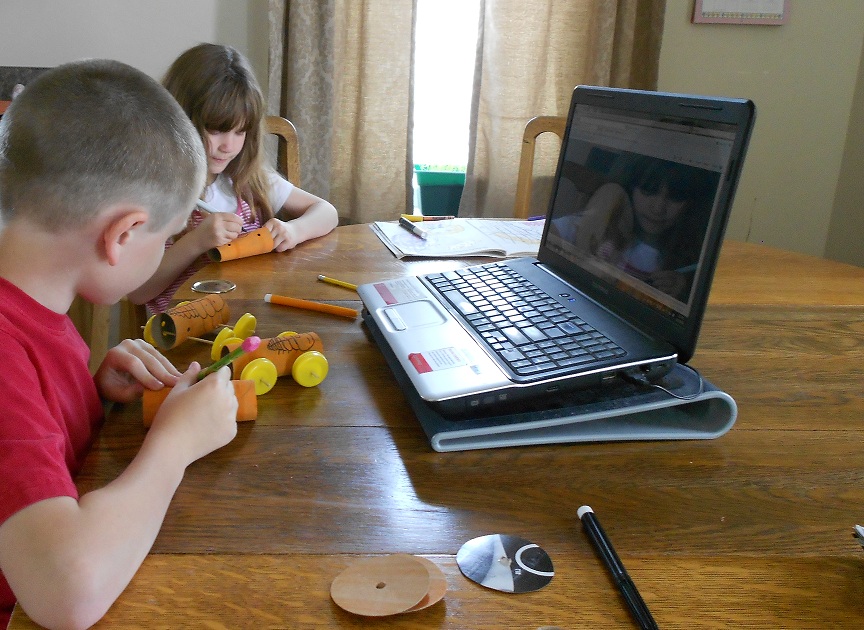
We combined science with craft time today, and ended up with a pretty fun toy in the bargain. The younger girls kicked things off for us, this morning, by painting toilet paper tubes orange.


When they were dry, I punched two pairs of holes in each one, to allow wooden skewer axles to fit through. I neglected to check the radius of the milk caps we were planning on using as wheels, and so ended up having to punch a second set of holes, lower down, later in the process. Chalk that up to, "Mom still has a few science lessons left to learn, herself."


The children then looked at the pictures we had taken of our larvae, and drew their versions on top of the toilet paper tubes (their portion of the science lesson). Some of the children took more creative license than others, but they all took their time observing, and discussing the pictures, and the insects.


We poked holes in the center of milk caps (this could have been a good math review, except the milk caps already had little dents in the center).


Then, we broke wooden skewers in half, removing their pointy ends, and used them to attach the milk caps, through the holes we had just poked, and punched.


After that, it was an afternoon of larva racing fun. If the real larvae can move as fast as our racers, the aphids don't stand a chance.


It's great to be a homeschooler.

Ugly Bug Breakfast Bread


I had great plans to make a ladybug bread for the children this morning, like one I saw over at Cafe Chocolada. Hers was a savory bread, with poppy seed accents. I didn't have any poppy seeds, and I wanted a sweet bread for breakfast, so I went with the Elisa Kleven's recipe from her Sun Bread book (if you don't have access to the book, you can find the recipe here, at Little Page Turners).


I mixed the ingredients in a bread maker, on dough setting, and then rolled about two thirds of it into a ball, for the body of the bug. Just remember, when mixing bread dough in a bread maker, it's liquid ingredients first, with dry ingredients on top, and yeast last.


I used a sharp knife to make a slit in the body, for wings. Then, I pressed on a small ball of dough, rolled in baker's cocoa (just to add color), for the head, reserving a bit of dough to make...


...eyes, and spots. I rolled the spots in the cocoa too, and made slits in the dough to press them into the body of the bug.


Finally, I covered it with a clean dish towel, and let it rise for fifteen minutes, before baking for 20 minutes (covered with tinfoil for the first 15 minutes) at 400 degrees Fahrenheit.


Clearly, I had some proportion problems with the head, and eyes, and poppy seeds work better for adding color than baker's cocoa. So, instead of a ladybug bread, we enjoyed an ugly bug for breakfast. Of course, after seeing the ladybug larvae, that didn't seem so wrong.


It's great to be a homeschooler.
Sunday, May 22, 2011

Bugs in The Backyard - Ladybug Larvae


I noticed this afternoon, that our ladybug eggs looked different. It looked like they had turned brown. So, I pulled the petal off of the dried up apple blossom they were sitting on, and moved it to a plate, where we could examine them through the magnifier.


And, sure enough - they were ladybug larvae. We watched them for a while, as they squirmed, and moved around, testing new, transparent legs. It was very interesting.


Then, being thoroughly satisfied that they were indeed ladybugs, we returned them to the apple tree, where we found them.


Right now they just look like little black dots, so there would be no way we'd see them, or any of the others, that I noticed have also started to hatch, on the bark of the tree. But, now that we know for certain they are ladybug larvae, we'll be keeping our eyes open for them, as they grow, over the next three to four weeks.

It's great to be a homeschooler.