Wednesday, April 6, 2011

Tiny Bird Cookies


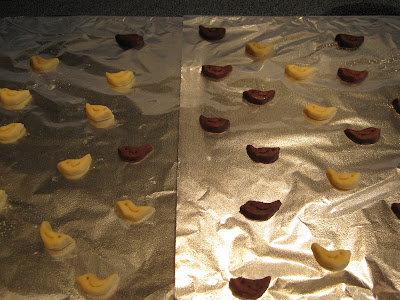
This flock of tiny bird cookies is made (as usual for us) with plain, and chocolate, sugar cookie dough. Any sugar cookie dough, including the store bought variety, would do.


Roll it out, and cut it with your smallest, heart shaped, cookie cutter. We used one, that came with our Easy Bake Oven.


Cut each heart in half.


Squish each half, down in the middle, to form a bird body, with an uplifted tail.


Pinch a beak into the round part.


And, use a toothpick to press in a dot for an eye, and a short line for the wing.


Bake at 35o degrees Fahrenheit for 5 to 8 minutes, until firm.


Enjoy!


It's great to be a homeschooler.

Tuesday, April 5, 2011

Birding Flashcards - Beginning Birding For Children


In case you stopped by looking for craft, or cookie ideas, don't worry - more are on the way. But, this morning we're busily cutting, and gluing pictures of some of the most common, and abundant birds in our area, onto note sized flashcards. We had so much fun looking for nests on Sunday, and we spotted a number of birds in the process, but realized pretty quickly how few of them we could actually identify.

There are 800 species of birds in North America, and according to Stan Tekiela, in the introduction to Birds of Montana (a guide we've found useful enough to purchase), there are 350 species in Montana alone. 136 of the most common are included in his field guide.

That's a lot of birds to get to know. Too many really for beginning birders. We needed to narrow down the list.

First, we started by finding a checklist of local birds, local as in those found in our county, from The Northern Prairie Wildlife Center online. They seem to have regional lists for all fifty states, so you might want to check them out, if you're planning any bird watching in the States.

Secondly, I highlighted all the birds marked as common, or abundant on the list. That narrowed our list of birds to seventy-five, which isn't too bad, when you consider many of them are birds of prey, or water birds, we probably won't be seeing in our backyard.

Then, I went through the list, searching for, and copying pictures online, mainly from Wikipedia, to make a personal database of pictures, that we can print out as wallet sized photos, for flashcards, or to cutout, and glue to construction paper for place mats, or posters...


...or as smaller thumbprint sized photos, to make jello-backed stickers, to add to our nature notebooks, as we spot the various birds this summer.


It's great to be a homeschooler.

Monday, April 4, 2011

Nest Spotting Drive and Nature Mapping - Beginning Birding For Children


The snow stopped, and melted, turning from a blizzard-like flurry, into a beautiful spring evening, in a matter of minutes, yesterday. You've got to love the spring! So, while we had clear roads, and fairly clear skies, we gathered the children, binoculars in hand, into the van, and headed out on a nest spotting drive (with the younger children anyway, because we had to drop the two oldest at youth group, on the way).

The Man of the House took us by a cavity nest, he'd spotted earlier in the week, on a business call.


But, for the most part we were looking for nests in trees...


...and on platforms.

Some, like this hawk's nest, even had a mother bird in residence. We kept our distance, but even so, she gave us a nice loud hawk scream of greeting/warning.


Of course, we had to stop to take a quick picture of a neighbor's domestic Bison, for you non-Montanans, just to prove we are in Montana (in case the mountains in the backgrounds of our photos aren't proof enough).


And, we spent quite a bit of time trying to count a herd of elk, grazing near the road. We lost count somewhere around fifty-nine.


On the way to take a look at an osprey nest, we caught sight of this little guy, fleeing the scene.


It was a good thing too, because near the osprey nest (which also had a bird in residence), we spotted a hawk's(?) nest, and while we were watching it, a large hawk (so large in fact it may have been a golden eagle) popped up, and soared off for some evening hunting. Needless to say, we'll be returning to that spot with a spotting scope, to get a better look at the gorgeous raptors.


We'll also be returning to our church with a tape recorder (or some modern equivalent), because while we were waiting to pick up the older children, after youth group, we could hear an owl calling from a group of large trees, and being answered by what we assumed was a mate, from somewhere further away. We spent quite a bit of time listening to owl vocalizations from the online Montana field guide, but would like a recording of "our" owl, for comparison.


...first, outlining our drive on a mapquest map...


...then sketching it out larger, so we could glue on thumbprint photos from our drive...


...and finally, taking a look at the satellite images on mapquest to add in some details, like the large pond to the east of the osprey, and hawk/eagle nest, and the river, and our favorite fishing hole, to the west.


We also spent some time reading Dean T. Spaulding's Housing Our Feathered Friends, a nest themed, nonfiction book, probably best for ages 8-12...


...Yvonne Winer's Birds Build Nests, a very simple, poetic, beautifully illustrated, picture book, about all different kinds of nests, including an identification guide at the back.


And, we watched a number of the "Inside Birding" tip videos from Cornell Lab's "All About Birds" site, which proved extremely helpful on our drive.

It's great to be a homeschooler.

Sunday, April 3, 2011

Matzah Bread a la The Little Red Hen

There's a very long back story to go with this post. I started to write it, but it was so long, I didn't even want to read it. Basically, it has to do with needing some, or unleavened bread, for an object lesson to go along with a Sunday School class for 5th and 6th graders, but being in a hurry (appropriate I think), and not being able to find any recipes, that didn't include eggs, and so settling on this one (click the link to view the recipe), which is very yummy, but wanting something a little more "official" to use in our own Passover study, before Easter, and finding this book at the library.


Phew!

Anyway, since we had communion today, at church, and the little ones wanted to know why it was little, flat "crackers" and "juice", and since we're supposed to have both sets of grandparents visiting, a baptism, and a birthday the week of Passover/Easter, and it was snowing too hard to go out for the nest drive, I had planned for this afternoon, I figured why not pull out the book, and make some matzah bread? And really, this is the short version of this post.

Leslie Kimmelman's The Little Red Hen and The Passover Matzah, follows the usual formula of the Little Red Hen story, but sets it in a Jewish farmyard, right before Passover. It's smattered with Yiddish (with a glossary at the back), and a fair amount of Passover tradition, and regulations, and has a flour and water recipe for matzah bread at the back, that has to be completely baked within 18 minutes of the water touching the flour.

I prepared the (non-kosher) ingredients...


...then set the timer, while the girls prepared to mix the flour and water.


They chanted, "Quickly, quickly, quickly," a refrain from the story, while I mixed, kneaded, and rolled out the dough, and then they stabbed it gleefully with forks, before we popped it in the oven. It was not a thing of beauty...


...and quite frankly, even served with honey, was not very tasty...


...but we managed to make it within the 18 minute time frame, and learned a little more about the traditions surrounding Passover, in the process, so no kvetching here!


It's great to be a homeschooler.

Saturday, April 2, 2011

Who's Afraid of the Big Bad Princess? Or, What My Child (and I) Are Reading.


After watching Disney's Tangled, which released to DVD on Tuesday, we read the old Brothers Grimm version of Rapunzel, out of our Worldbook Childcraft set. You can read it online in several places, including here, at GrimmStories.com, if you can't quite remember how the old story compares to the Disney remake (while you're there, you might want to click H.C. Andersen link, and read a few of his stories too - it's his birthday, today, you know).

Then, I read Peggy Orenstien's Cinderella Ate My Daughter, Dispatches From the Front Lines of the New Girlie-Girl Culture, after hearing a blurb for the book on NPR, also that morning.


Orenstien is about nine years older than I am (meaning she missed out on the whole transformation of Prince Charming into the rowdy, skirting the law, yet adorable Han Solo/Starbuck/Remington Steele type hero we find being somewhat spoofed in Tangled), a feminist, and mother to one daughter (as opposed to my four), and she is not a Christian, so her viewpoint is quite different than my own, and it is the type of analytical, socio-psychology, that I don't usually read.

Even so, her short tome of motherly worry was interesting, and mostly entertaining. It would make good fodder for a book club discussion. Basically, it's a book of warning about the dangers of socialization, and as a mother of homeschoolers - that really, really made me laugh.

Beyond that, we read a whole plethora of picture books about birds, and their nests, but I'm hoping to save those to go along with tomorrow's post.

As usual though, you can find more book reviews and recommendation for children (and sometimes for their mothers, too) over at Mouse Grows, Mouse Learns' What My Child Is Reading link-up.

It's great to be a homeschooler.
Friday, April 1, 2011

Nesting Bag Success

We noticed today, that it looks like birds (we hope it's birds) have been pulling some of the fluff out of our nesting bag.

We haven't actually seen any birds near the bag, with the exception of one male robin, who hopped up on a nearby branch, before flying away. Maybe he went to tell his "wife".

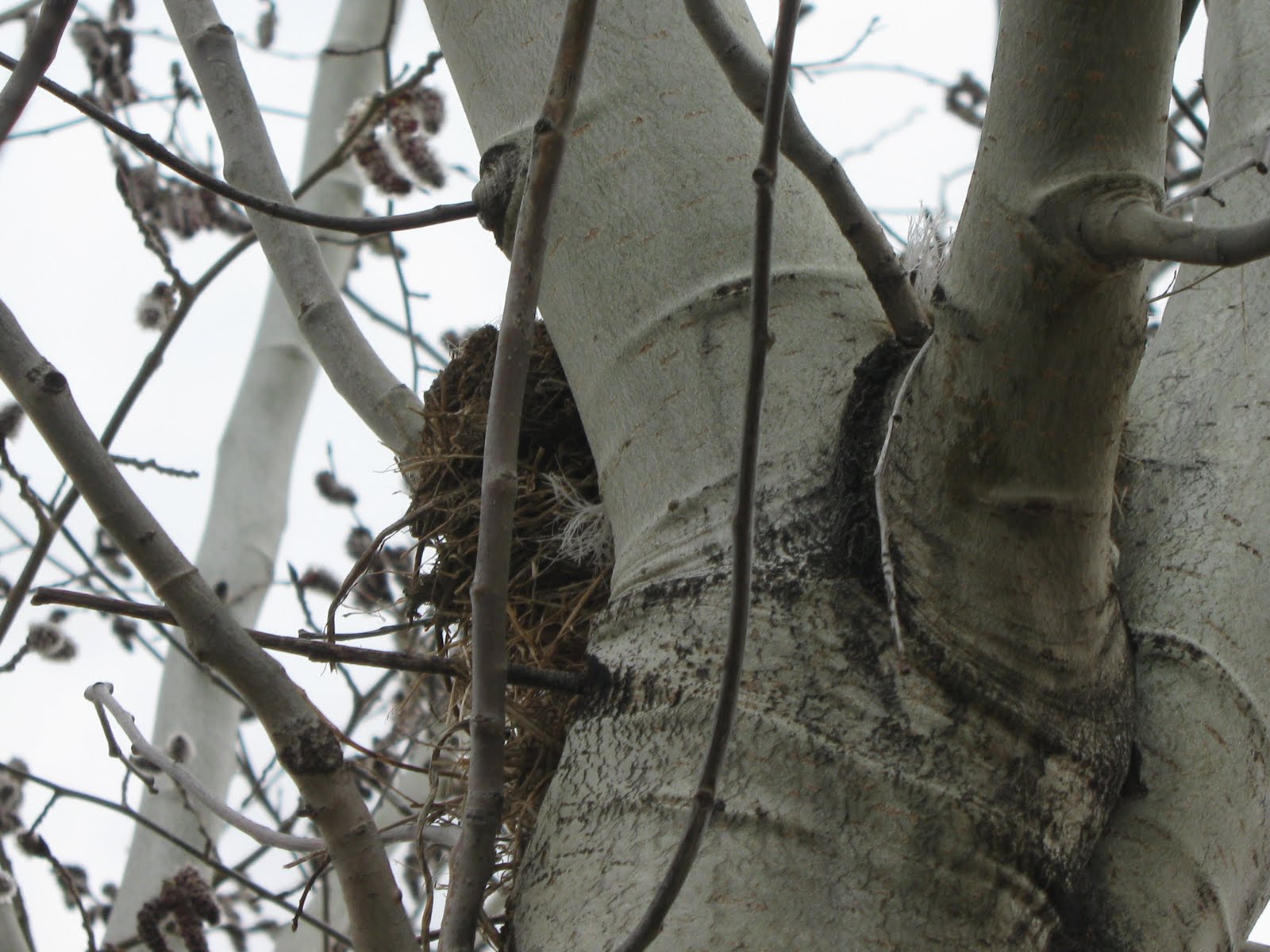
I don't know, but when we sauntered over to check out the nest nearby, sure enough, there were new bits of fuzz, and fluff sticking out of it, and one piece of gray yarn woven into it, that wasn't there before.


It's great to be a homeschooler.

Conquering the Colored Carnation, Capillary Action Experiment

The capillary action experiment, involving placing a white carnation in colored water, and watching the color rise, through the stem, into the flower, is one of those old, tried, and true experiments, that I've noticed most of us fail at.

I have to admit to failing at it several times over the last few years. A fact, that was particularly frustrating to me, because I was sure we made it work, the first time we tried it, back when T was somewhere around three.

I wanted the younger children to get the whole wow! effect, that I remembered. But instead, for some reason, although we got some results, they were generally dismal - just the tiniest hint of color making it out to the tips of the petals.

Then, I read (and I have no idea where), that the trick is to use more food coloring.

So, last night when I happened on white carnations at the grocery store, I snatched them up, to try again. This time, we used a lot of food coloring - A LOT - as in 1 tablespoon per quarter cup of water. I was running low on red food coloring, so my attempt at red, and orange, had slightly less food coloring, but the blue, green, purple (which we had in an already mixed form), and yellow, received the entire dose.


Within an hour, we were seeing results.


And this morning - success!!!


It was interesting to watch the orange, and purple. Blue, and yellow rise much faster than the red. And, while our red is not as RED as it might of be, next to the other bright colors, the pink is still pretty.


It's amazing how much more attentively children will listen to a lesson on transpiration, cohesion of water molecules, and capillary action, after being wowed by a bright rainbow bouquet.

Check out Steve Spangler's site for an easy to digest, scientific explanation of this experiment.

And, don't forget, that Sunday there will be lots more science fun for children to be found, over at Adventures in Mommydom's Science Sunday link-up.

It's great to be a homeschooler.